


Karina Shevchenko
Financial Expert at Finmap
Niche Expertise
Education
Diplomas and Certificates



Author's Posts

ThinkGlobal Case Study: Building a Private School with 54M UAH Revenue
The success story of Yana Moskovchenko. Discover how ThinkGlobal and KUKU Kids moved from Excel to Finmap and established a systematic financial tracking system in education.
Read

FREE

1.9k

7 min

30.12.2025
Yana Moskovchenko is the head of the ThinkGlobal private school (Petropavlivska Borshchahivka) and the KUKU Kids kindergarten. Her business journey didn't begin with a business plan, but with a mother’s desire to find a place for her daughter where she wouldn't be "broken" by the rigid frameworks of the state system. Today, Yana manages a business with an annual revenue of 54 million UAH (≈ $1 272 770), organizes GLOBAL FRIENDS family camps worldwide, and knows the exact profitability of each project thanks to Finmap.
We talked with Yana about the "Titanic" of state education, managing a business during the war, and why a well-structured financial tracking system is the best stress prevention for a business owner. Below is Yana’s story in her own words.

From Civil Servant to Entrepreneur
Since childhood, I dreamed of working with children. However, my father had his own plans: “Yana, what, are you going to be a pediatrician? Or a kindergarten teacher wiping kids' noses? An accountant — now that’s the best profession in the world.” I received my degree in Finance and Auditing, showed it to my dad, and never worked a single day in that field.
I worked in the Department of Land Resources. But with the birth of my daughter, I realized I didn't want to return to civil service after maternity leave. I loved focusing on her development so much that I started diving deep into the topic, retrained, and began leading classes. In 2011, this evolved into my first early development center in Petropavlivska Borshchahivka — simply because I had nowhere to take my own child. As my daughter grew, I wanted to develop further, so I bought a kindergarten franchise.
“I borrowed $10,000 from acquaintances and bought the franchise for the 'Kuzya' children's early development center. At that time, it was an astronomical amount for our family. But I simply believed in the idea. And because of that, we never worked a single day at a loss.”
Breaking Stereotypes in State Schools
When my daughter started first grade at a state school, it was a total culture shock. After a private kindergarten, the child felt "suffocated" by the systemic rules. She didn't understand why she had to do things that made no sense or why she wasn't allowed to make mistakes. It was then, in 2017, that I bought the ThinkGlobal franchise.
“I was buying 'air.' Just an idea that I believed in deeply. Now it’s a large franchise with many schools in different cities. But back then, I was among the pioneers. What I learned in that first year was a quantum leap in business building and my personal growth. I never regretted starting with a franchise — it helped me avoid many mistakes.”
Team, Management Style, and the "Hugging Method"
I have 26 employees in the school and 7 in the kindergarten. When picking people for the team, besides evaluating hard skills, I have one secret method. I ask myself: “Do I want to hug this person?” If the answer is yes, they are our teacher. School is about the soul and the atmosphere; people spend the whole day here, so it’s like a second family. Atmosphere is especially important for Gen Z — it has to be high-energy, or they won't work. And I need exactly those energetic people.
Regarding management style, I am soft and democratic. Sometimes even too much, so I’m currently working on learning how to say "no." I am very loyal and value relationships — perhaps the friendly vibe in the team is more important to me than purely professional metrics.

We are a "School of Meanings"
We explain why every subject is necessary. We teach adaptability because professions are disappearing fast. Our lessons are modern: neural networks, rhetoric, business, journalism. My mission is for senior students to understand what they want, rather than just getting a diploma.
For me, success is when a graduate of my school comes back in 10 years and says: “Yana, thank you for not breaking me in school, but for teaching me to believe in myself.” And all while my business is stable, profitable, and gives me the opportunity to travel and enjoy life.
The core is emotional intelligence and communication
Psychology is mandatory for us. It’s not science from a textbook, but practice: how to communicate using "I-messages," how to talk about fears, and how to set boundaries (“Stop, this is unpleasant for me”). We teach conflict resolution—solving problems through "words from the mouth."
Students, when they see me, shout: “Yana!” and hang on me like grapes; they might even pull me down to the floor because we are in such warm and friendly relationships. I always have something nice to say: “what a wonderful bow you have,” “what a lovely sweater,” “I was told how cool your answer was in class, well done!” I love children, and they feel it.

.webp)
The Education Market: "A Small Boat Next to the Titanic"
State education is a massive "Titanic" that is hard to turn around quickly. A culture of fear regarding mistakes still dominates there. A child must get a perfect score the first time, or it's a disgrace. Our children are free. When a child comes from a state school, we "take them out of their shell," showing them that it is safe to make mistakes. If it weren't for Ministry of Education standards, I would abolish grades entirely until the 8th grade.
I see opportunities everywhere
War, as strange as it sounds, provided quite a few. Blackouts caused an influx of children to us. State schools are machines that are difficult to heat or provide with light. In our case, it’s always warm, there’s internet, and we feed everyone. We became "Points of Invincibility" for our parents.
The private education market will grow until the state can provide a high-quality level for free. The children currently studying in private institutions or abroad who return will be the elite that shapes the country.
.webp)
Advice for Entrepreneurs and Those Starting an Educational Business
- Do not be afraid. The demand for high-quality education in Ukraine is huge.
- Search for meaning. If you go into education only for the money, you will burn out quickly. You have to love children and be on fire for the mission.
- Calculate the financial model "on the shore" (before starting). Don't open a business blindly.
On Finance and Moving Away from Intuitive Management
At one point at the beginning of the full-scale invasion, I even thought about selling the school due to instability. But I realized that selling a business with just an "Excel sheet" was unprofessional. I heard about Finmap at a conference, implemented it, saw the real numbers, and said: “Wow, I’m earning this much! Why would I sell this?”
“Right now, I have a revenue of about 54 million UAH per year. The profitability for the schools is approximately 46%, and for the kindergarten, it's lower — around 14%. I know all this because I was preparing for the interview. It took two minutes: I just opened the Finmap app and checked everything,” Yana laughs
Life Before Finmap
Before this, everything was in Excel, and it was terrible. There were journals, everything was written by hand: how much we received, how much we spent, then we would try to reconcile these records, and they wouldn't match. Until I visited a location or called, I didn't know how much money was actually in the cash register. I had to constantly monitor it and keep it in my head: where did we forget to record something? Why is there a shortage? Why doesn't it match Excel? It was a nightmare. I don't even want to remember it.
Finance Now
Finmap helped me automate everything. When forming the tuition fees for the next year, I rely on data regarding rent in foreign currency, salaries, and expenses. It’s even a psychological factor: when I look at the numbers, I know for sure: I can pay the rent, I can maintain the school, there’s enough to pay salaries — everything is fine!
I have two school locations and a kindergarten. Each has administrators with their own cash registers. They have access to Finmap and categorize payments "on the shelves." I can see the balances in every register at any moment. Separately, I manage the "Camps" project. This allows me to see how much money can be allocated to advertising and how much is net profit. It’s like building towers from blocks: I can see where I took a piece from and where it needs to go back.
“I used to do a lot of things with my own hands, spending my life's resources on it. The money I now pay for Finmap is nothing compared to the work I was forced to do before. It is a very profitable investment.”
Implementing Finmap: From Team Resistance to “How Did We Live Before?”
Generally, everything new is accepted by the team through resistance, by proving its value to them. Sometimes it just needs to be "pushed through." Naturally, everyone wants to work as before and change nothing. I said: “Listen, you don't want to ride horses or wash clothes by hand, do you? We are installing a 'dishwasher' for finances so that it’s done for you.”
But there was great support from the Finmap team. First, I figured it out myself, and then Finmap organized an online meeting for my employees. They explained everything, and the team realized: “Aha, this isn't hard at all.” After a month, they were already telling me: “Yana, this is great! How did we live before?” The administration got rid of a massive chunk of work. And now I feel freedom: I can be in another city, open my phone, and see the real state of affairs.
“From a financial tracking perspective, Finmap is the best option for me. I am truly a big fan of the service. It frees up time for yourself: for love, for growth, for the opportunity to taste this universe.”
Experience financial peace of mind today!
Book a free Zoom consultation with our CFO or request a Finmap demo to see for yourself how much easier management becomes when the numbers work for you.

Hot Mamas Case Study: Automating Finances to Reach 800,000 UAH in Revenue | Finmap
The Hot Mamas success story: how to transform a sex shop into a leading educational brand, reach 800k in revenue, and master financial management with Finmap.
Read
FREE
1.6k
6 min
26.12.2025
How do you build a business in a niche where Instagram can shadow-ban you for a single image, and influencers are often too hesitant to review your products? What do you do when sales suddenly drop, but you can’t pinpoint why because your accounting is managed "in your head" or in a paper notepad?
Today, we are joined by Natalka — co-founder of Hot Mamas, an educational sex toy boutique. We discussed the normalization of sex in Ukraine, maintaining a friendship within a business partnership, and how implementing systematic financial management revealed the true health of the business, as clear as day.
The Journey: From a Glass of Wine to a Team of Six
How It All Began
The store was co-founded by Natalka and Dana. At the time, they were already building their own Instagram blogs and had established a significant media presence. This visibility became the launchpad for their own venture:
Dana and I were just drinking wine at her place, brainstorming... Since we were bloggers, other sex shops would send us products for promotion. I realized I enjoyed advertising those products much more than, say, handmade soaps — which was the big trend back then. When I was offered sex toys, I thought, 'Great, let’s do it, I can really talk about this.' People listened to us, they trusted us, and we eventually said, 'Why don't we sell them ourselves?' And just like that, it took off.
The name was born that same evening. The priority was to avoid clichés like "strawberries" or "peppers." Since Natalka was already a mother and Dana was her daughter's godmother, Hot Mamas felt like the perfect fit.

Partnership and Team
The founders met at a makeup course and had been friends for two years before launching the business. Working together became a true test of their relationship:
At first, everything was viewed through rose-colored glasses. I thought, 'Oh my god, she’s so great, I’d marry her!' But then you realize you are two different people with different perspectives. You have to learn to compromise. We’ve had our conflicts, but I’m the type of person who tends to smooth things over, so we maintain a healthy balance.

Today, the team consists of six professionals: an operational director, a content creator, a personal assistant, and managers handling logistics and customer service. Natalka serves as the CEO, focusing on the numbers, while Dana is the creative face, overseeing the website and communications.
Market Challenges and Niche Specifics
Education as a Foundation
Hot Mamas is more than a store; it’s an educational platform. The founders don’t claim to be clinical experts; instead, they focus on normalizing the conversation around sex:
There is a massive gap in sexual education. We started explaining that toys aren't about 'indecency' or 'vulgarity' — they are about self-exploration and wellness. Our audience connected with us because they realized, 'Oh, they feel the same way, I’ve experienced that too.' We make them feel that their needs are normal.
Natalka and Dana have turned education into a lifestyle brand. Their candid and humorous videos help break down social taboos. The numbers speak for themselves: the main Instagram page @hotmamas_shop has over 36,6K followers.

Their personal pages are equally influential: Natalka has 10,3K followers and Dana has 20,8K.


Their YouTube project, Hot Mamas Show, has become a genuine media hub for open dialogue, with over 3,5K subscribers. Their content frequently goes viral, with top videos reaching over 7K views, proving the high demand for modern sexual education.

Navigating Censorship and War
The primary hurdle remains social media censorship. Even global brands are forced to blur products or use "leetspeak" to avoid being banned.
If we were selling vacuum cleaners, I can’t imagine where we’d be by now. In this niche, you are constantly innovating just to stay visible. We tried doing product reviews on YouTube and were hit with a ban almost immediately. Even influencers are often too shy to collaborate; they still view the topic as taboo.
The war adds another layer of complexity. Natalka shares how "mom brain" tries to adapt to the ongoing crisis: despite shelling and blackouts, the business persists.
The shelling might start in the morning, but then I see a Shopify notification — a new order. Life goes on.
Customer Profile and Seasonality
80% of their customers are women. Men, on the other hand, sometimes feel threatened by the products. Natalka recalls an instance where a friend’s husband threw away an unopened gift:
They often view toys as competitors, rather than allies in a relationship.
Seasonality also dictates the rhythm of the business:
- Peak seasons: December, Valentine's Day, and Summer.
- Low seasons: September and October. "September is quiet. No one is focused on sex; everyone is sending their kids back to school," Natalka notes with a laugh.
Reflecting on the market's evolution, Natalka says:
When we started, most shops were Russian-speaking with cringey, dated aesthetics. Today, the industry has become much more aesthetic and professional. However, while the niche is growing, it is much harder for newcomers to gain traction now than it was for us.
2026 Strategy: Scaling and International Expansion
While Natalka jokes that her personal "scaling" involved pregnancy and motherhood last year, the business isn't slowing down. The team is currently exploring a franchise model to expand their reach.
A top priority is expanding into the Polish market. According to the founders, the demand is already proven:
We see a huge number of our people abroad. Both the local Polish community and Ukrainians living in Poland are actively buying from us. While Poland has its own shops, we believe there is a specific audience there that resonates with our unique, educational approach.
Financial Management: From a Notepad to Automation with Finmap
The "Before" Era: Manual Bookkeeping
In the early days, financial management was instinctive rather than systematic. Everything was tracked manually in a notepad.
I kept everything in my head and a single notepad. I managed all the cash flow and would simply tell Dana: 'Pay this bill, here is your salary, and here is mine.' That was the extent of our accounting.
The Turning Point: "Where Is My Notepad?"
The need for change arose when sales fluctuated and the owners wanted to identify the root causes to prepare for scaling.
We wanted to seek professional consulting, and the first thing they asked for was our data. I looked for my notepad, but realized it wasn't enough for a growing business. Dana, who is always pushing for modern solutions, insisted we simplify and automate. That’s how we discovered Finmap.
The Result: "A Real Eye-Opener"
Natalka admits she was initially hesitant about the discipline required for digital logging, but the results were transformative:
Comparing my old manual notes to what we have now is like night and day. Now, I can check my phone at any moment and see exactly what’s happening. All accounts, graphs, and trends are right there in the palm of my hand. I finally know our exact budget — what we can reinvest and what we can save. The peace of mind is incredible.
Automating with Finmap allowed them to track their real margins (which range from 50% to 100%) and plan for a team of six. As CEO, Natalka now manages the company’s finances with professional precision, keeping a finger on the pulse of every transaction.
Finmap belongs in every business! — Natalka concludes.
Build a Transparent Financial System for Your Business
If you are still managing your accounts "in your head" or spending hours on manual spreadsheets, it is time for a systematic upgrade. Finmap helps entrepreneurs eliminate financial chaos through automatic bank synchronization and intuitive reporting.
- P&L Report: Understand your real profit, not just your bank balance.
- Cash Flow: Prevent cash gaps and plan future expenses with confidence.
- Automation: Your transactions sync automatically — no more manual data entry.
- Full Visibility: Professional tools that make financial management simple and scalable.
Get a clear view of your business today
Book a free Zoom consultation with our CFO or request a Finmap demo to see for yourself how much easier management becomes when the numbers work for you.
.webp)
I AM IDEA: From Excel Chaos to Financial Control
How the marketing agency moved from Excel to Finmap, automated its finances, organized its cash flow, and got out of “zero.”
Read
FREE
1.8k
11 min
22.10.2025
How many more months are you willing to work “at zero” and comfort yourself with growing lead numbers?
In spreadsheets, everything looks fine — new clients, more projects, movement. But by the end of the year — a red line and an empty account.
This is a case about a marketing agency that took an honest look at its numbers, got out of the red, and stopped playing the “we’re growing” game. Not a motivational fairy tale — but a step-by-step breakdown of how chaos made of small payments, freelancers, and broken formulas can be turned into a managed P&L, transparent profitability, and time that finally works toward scaling.
Spoiler: Excel doesn’t save you here.
About the Client
Alina is the founder of the marketing agency I AM IDEA, which works with Ukrainian businesses in Ukraine and diaspora-based companies abroad. The team operates as an external marketing department: not just “doing advertising,” but diving into business processes, building structure, and taking responsibility not only for results but also for process management.
The agency deliberately avoids a narrow niche — it works with different business models and selects clients based on their level of business maturity: from business architecture and monetization model to the presence of a sales department and financial management — factors that directly affect the long-term effectiveness of cooperation.
The business model is modular: clients can engage either for one-time services or for ongoing, system-based management.
The Problem
The agency model looks attractive during growth, but it’s financially demanding: dozens of small transactions per project, partial payments to freelancers, reconciliations, and balance control. All of this multiplied by manual tracking in spreadsheets leads to cash gaps, delayed payments, and the absence of a clear picture of profitability.
1. How It Felt in Operations
- Manual data entry + unstable formulas → errors and wasted time.
It was hard to manage in spreadsheets because I had to create all the formulas myself. — Alina, founder of the marketing agency I AM IDEA
- Many small payments per project → control became scattered.
The agency model is challenging because there are so many payments for a single project. You have to pay freelancers and so on. It’s not one salary for one person, but several smaller payments. — Alina, founder of the marketing agency I AM IDEA
- Cash gaps as a result of poor forecasting and cash flow management (not just categorization).
We faced cash gaps because assigning categories to finances is one thing, but managing them is another. — Alina, founder of the marketing agency I AM IDEA
- Founder overload: everything depended on the owner, analytics was occasional.
It was difficult to manage such a large number of figures across different projects. — Alina, founder of the marketing agency I AM IDEA
Problem Map
2. Where the Agency Model Breaks Without a System
The agency receives a fixed payment twice a month, but payouts to freelancers and contractors occur at different times and in smaller portions.
Without a centralized project-based P&L and automatic categorization rules, it’s difficult to see the real margin and identify the moment when there seems to be enough money in the account — but the cash flow is already “in the red.”
Points of Control Loss
3. Organizational Problems
- Information was stored in the founder’s head → the team lacked transparency and constantly asked whether payments had arrived.
- Expense control was reactive, not preventive: analyzing “after the fact” no longer saved the month.
- Focus shifted to operations instead of growth: an increase in clients didn’t translate into healthy profitability.
How Finmap Was Implemented
Unlike the typical scenario where automation is introduced after a painful cash gap, Alina’s decision was conscious and planned in advance. Financial control is part of the founder’s DNA — a mindset shaped during her previous career in management roles.
I was just waiting for the moment when I could pay for the subscription, because even before connecting, I had visited the Finmap website many times and knew the annual rate in advance. There wasn’t a turning point or special situation — I was consciously moving toward this from the very beginning. — Alina, founder of the marketing agency I AM IDEA
Why Finmap?
Alina’s background is all about structure: process building, management reporting, and control. That’s why the tool was chosen for its ability to sustain and organize processes.
My background is like this: I worked at a law firm, have a degree in law, built my career there, and became a deputy director — that’s where I learned business processes and financial reporting. I knew about different automation tools, so it was obvious to me that I would use financial management software, and Finmap turned out to be the best solution. — Alina, founder of the marketing agency I AM IDEA
The Logic Behind the Decision
Now I’ve moved to the PRO plan. — Alina, founder of the marketing agency I AM IDEA
How Finmap Was Implemented
Roles and Areas of Responsibility During Implementation
What Helped Make the Decision Without a “Turning Point”
- Management background: greater trust in numbers than in intuition.
- Understanding of the agency model: many small transactions = high demands on the system.
- Founder’s time priority: a systematic tool = less manual routine.
How Finmap Solved the Problems
Finmap freed the founder from manual bookkeeping and provided a unified money management system — from project cash flows to team payments. The key was the combination of automation, P&L, and the Projects feature.
The result — transparent margins, less chaos, and faster decision-making.
Now all payments come in, and I assign categories. Yesterday, I upgraded to the PRO plan to have both P&L and automation rules — I’d wanted that for a long time, so now it’ll make my work even easier. I use P&L and Projects the most — they’ve really saved me time, and I can check any information by filters or categories at any moment. — Alina, founder of the marketing agency I AM IDEA
1. Pain → Solution in Finmap
We’ve freed up time: now everyone can check the numbers they need on their own, no one distracts me, and it’s become easier to analyze the data. — Alina, founder of the marketing agency I AM IDEA
2. Daily Work in the System
- Payment reception → automatic entry into the feed → category assignment.
- Project-based accounting → linking all small payments to a specific project → visibility of actual cost.
- P&L → reviewing profitability by months/projects → making decisions on pricing and expenses.
- Team access → managers can see the numbers they need → fewer questions to the founder.
- (Pro) Automation rules → ability to set up typical payment patterns → even less manual work.
3. How Finmap Helped Overcome Cash Gaps
- All operations in one place → no more gap between reality and spreadsheets.
- Expense linking to projects → accurate cost calculation instead of “estimates.”
- P&L by periods → early visibility of “red” months.
- Category filters → detection of margin “leaks” (small and recurring expenses).
- Regular payments in the operations calendar → payouts are planned based on real cash-in.
4. The Role of Pro Features
- P&L (extended) — deeper margin insights by clients, channels, and months.
- Automation rules — planned reduction of manual steps, creating stable “tagging” for typical transactions.
- Quick filters and team access — team independence without bottlenecks.
When you have Finmap, you instantly understand what’s going on, you can analyze expenses, avoid overspending, and it was thanks to Finmap that I managed to get out of the red. — Alina, founder of the marketing agency I AM IDEA
Insights from Alina
1. Money ≠ Sense of Growth
The number of leads and projects doesn’t equal profit. You need system, not intuition.
And what’s most interesting — when you’re just starting out, it feels like everything is growing: things are moving, clients are increasing, everything’s great. But the numbers tell a different story. — Alina, founder of the marketing agency I AM IDEA
Action: Review P&L every month and make decisions based on margin, not feelings.
2. Early Financial Tracking Saves You from Painful Reconciliations and Self-Deception
The earlier you start systematic financial tracking, the fewer surprises you’ll have at the end of the year.
I didn’t hesitate to invest in it right away, because I wanted to consolidate the data for the entire year. — Alina, founder of the marketing agency I AM IDEA
Action: Connect Finmap from “day one” to avoid difficulties during year-end reconciliations.
3. Automation Is More Reliable Than Formulas
Spreadsheets can’t handle the agency model with dozens of small payments.
When I had to enter everything manually, it was very long and complicated: working in spreadsheets is hard because you have to create all the formulas yourself to get the numbers you need. — Alina, founder of the marketing agency I AM IDEA
Action: Move all operations into the system and set up automation rules.
4. Transparency for the Team Saves the Founder’s Time
When figures are accessible by roles, the “bottleneck” in management disappears.
My team doesn’t ask whether a payment has arrived — everyone can see the numbers they need, so in that sense, no one bothers me. — Alina, founder of the marketing agency I AM IDEA
Action: Set up access permissions and personalized dashboards for each role.



5. An Honest P&L — Uncomfortable, but It Saves You
Reinvestments without control can easily mask losses.
When summing up the results for the entire 2022, I saw that every single month was ‘in the red’ in terms of profit. — Alina, founder of the marketing agency I AM IDEA
Action: Tag reinvestments under separate categories and calculate margin per project.
6. Financial Reporting ≠ Accounting
An accounting report is not a management tool.
Action: Implement a management P&L, profitability KPIs, and a cash flow forecast.
7. Early Transition to Systematic Management = Faster and More Honest Decisions
Unpleasant doesn’t mean wrong.
The earlier an owner clearly realizes their real situation, the faster they can make decisions — perhaps unpleasant ones, but at least honest ones. — Alina, founder of the marketing agency I AM IDEA
Action: Review expenses weekly and make monthly decisions about pricing and staffing.
8. Finmap as the “Source of Truth”
Operational reality must match the numbers.
Finmap is the first source I use to check how much has been paid, and I compare its data with other sources. — Alina, founder of the marketing agency I AM IDEA
Action: Keep Finmap as the main tool for management reporting, and use spreadsheets only as a planning aid.
9. Automation Rules — The Next Level of Efficiency
Set them up gradually, tailored to the agency’s specifics.
Action: Start with 2–3 automation rules for the most frequent patterns (recurring payments, commissions, salaries).
What Alina Would Do Differently (Based on Her Experience)
- Connect Finmap earlier to avoid reconciling the entire year retroactively.
- Structure categories for the agency model from the start (salaries / freelancers / project costs).
- Separate reinvestments into a distinct layer to avoid “eating up” the P&L.
- Set up access rules already during onboarding so the team can work independently from day one.
Next Steps
Alina has already switched to the PRO plan and plans to build out the agency’s “financial engine”: automate routine tasks, dive deeper into project-based P&L, stabilize cash flow, and make the team financially autonomous.
Goals for the Next 6–12 Months
- Scale the client portfolio without increasing operational workload (automation rules to cover ≥80% of transactions).
- Dynamic pricing: review retainers every six months based on P&L data.
- One-year financial model in Finmap: “base / optimistic / cautious” scenarios.
- Educational framework for the team: short SOPs on financial discipline for each department.
The story of I AM IDEA is an example of how an honest look at the numbers can transform not only financial results but also the very culture of business management. For the team, Finmap has become more than just a financial tool — it’s a coordinate system where every payment, project, and decision has its place.
The transition from spreadsheets to automated management proved: Excel is great for reports but not for a growing business. True development begins when an owner stops working “blindly” and starts seeing not just the movement of money but the logic behind profitability.
For Alina and her team, Finmap has become the “first source of truth” — a space where data aligns with reality, and the time once spent on reconciliations now drives growth.
Financial systematization is not a luxury or a result of growth — it’s the condition that makes growth possible. And this case proves: financial automation is not about numbers — it’s about control, calm, and strategy.
Frequently Asked Questions
1. Can I start financial management in Finmap without historical data?
Yes — and that’s actually optimal. You’ll immediately get an accurate P&L and cash flow forecast. Historical data can be uploaded later in batches.
2. Is Finmap suitable for an agency model with freelancers?
Yes. “Projects,” P&L, and automation rules give full control over project cost and margins, even with dozens of small payments. No more manual reconciliations or formulas.
3. How does Finmap help avoid cash gaps?
Through cash flow forecasting and planning payments according to actual inflows. You can see when money will run short and which expenses should be postponed. This helps build a buffer and stabilize the payment calendar.
4. Can financial control be delegated to the team?
Yes. Role-based access allows department heads to view their own numbers without seeing the entire account. The founder stays focused on control and decisions — not manual routine.
5. When is the right time to move from Excel to Finmap?
When you spend more than two hours a week on bookkeeping or manage 5+ contractors or projects simultaneously. Also, if you patch your forecast every month or don’t see project margins. Transitioning earlier saves dozens of hours and prevents costly mistakes.
%20(1).webp)
Financial Stability of Local Businesses: How Systematic Management Helps Avoid Cash Gaps
How a local business can avoid cash gaps, establish cash flow control, and build a stable financial system
Read
FREE
2.1K
9 min
15.10.2025
If you’re the owner of a local business, you’re involved in daily operations: managing sales, overseeing purchases, communicating with suppliers — all while trying to keep your finances under control.
But even when everything seems to be running smoothly — clients are coming, revenue is steady, the team is motivated — there still might not be enough money.
The reason isn’t always a drop in sales or external factors. Often, the issue lies deeper — in invisible financial processes that gradually reduce profitability and create a sense of instability.
Let’s look at three main financial challenges local businesses face — and see how Finmap helps bring order to cash flow, restore predictability, and bring back peace of mind.
.webp)
Problem №1. Cash Flow Out of Control
In local businesses, everything starts with cash flow. This indicator determines whether the business has enough resources for stable operation and growth.
The main problem for most local companies is the lack of systematic control over cash flow. An owner might see decent revenue but still fail to understand:
- when exactly money appears in the accounts;
- how much of it is already reserved for mandatory expenses;
- and what amount remains freely available.
The lack of this understanding creates financial tension:
- payments are made without a clear plan;
- cash gaps appear;
- some expenses go unrecorded;
- and strategic decisions are made without accurate data.
When cash flow isn’t tracked daily, a business gradually loses control.
From the outside, it may look successful — there are clients, there are sales — but internally, a liquidity deficit is already forming.
Consequences of Uncontrolled Cash Flow
It’s the gap between “on-paper” profitability and actual money that becomes the main cause of financial instability.
Download the Checklist “Is Your Business Financially Secure?”

To restore control and predictability, you need to establish a clear cash flow management process.
Below are three key steps that mark the beginning of effective money control in a local business.
Control
- Create a unified base of financial data and add all your accounts — bank, cash, and card — into a single system. This allows you to see the full picture of money movement in real time.
- Record all transactions daily — income, expenses, and transfers between accounts. Regular updates help you avoid cash gaps and clearly understand how much money is actually available.
- Automate this process using bank integrations and automation rules — this will reduce manual work and increase accuracy.
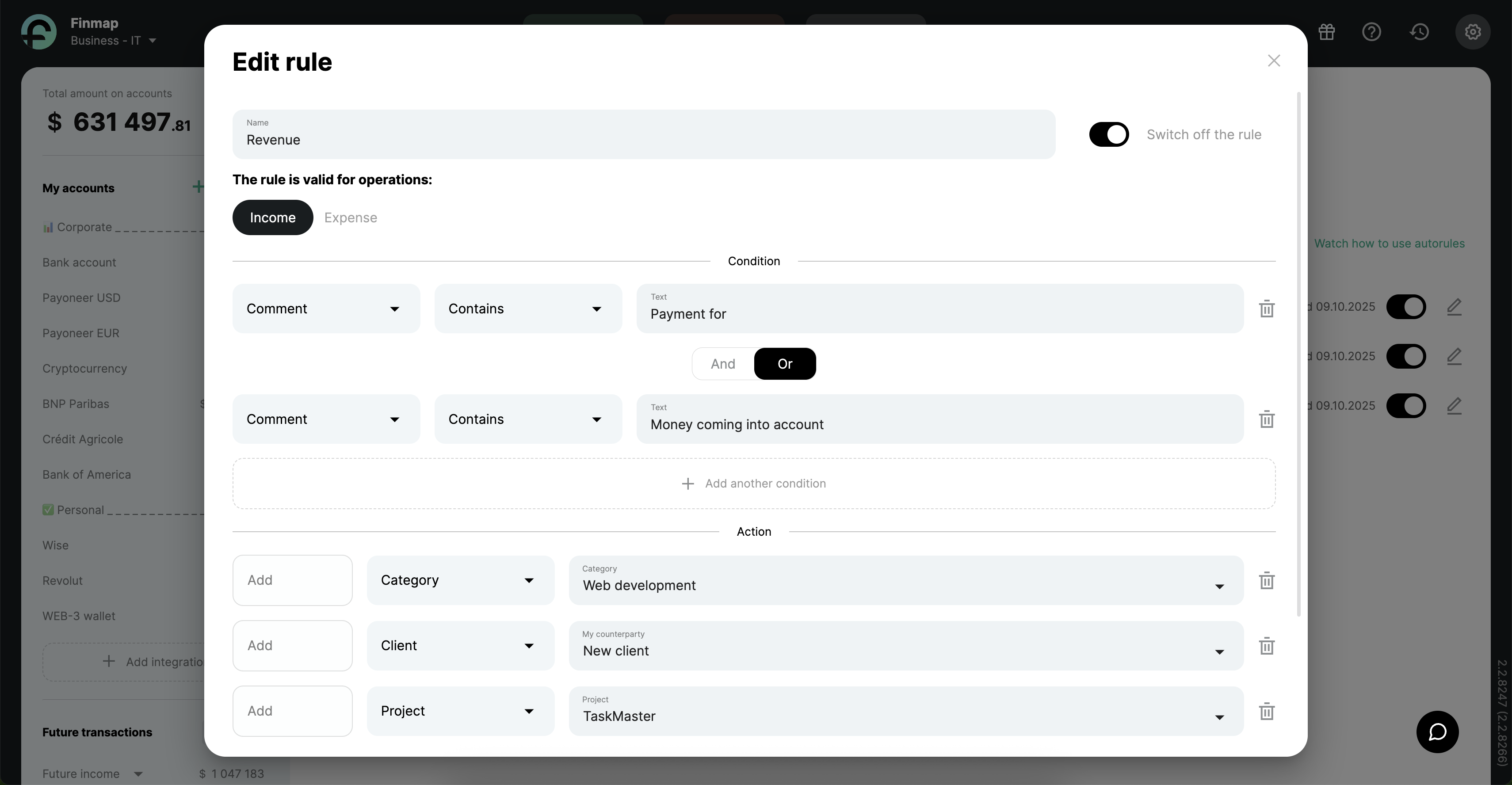
In Finmap, setting up this process takes no more than 20 minutes:
- You can create an unlimited number of accounts in different currencies;
- Connect integrations with the most popular banks and payment systems;
- Set up automation rules that allow the system to handle transaction entries for you, saving 60–70% of manual processing time.
Analyze
- Analyze by categories to see which expenses are increasing and which ones generate income. This helps you quickly identify inefficient cost items and make data-driven decisions.
- Track revenue dynamics — monthly or weekly — to spot patterns and seasonality.
- Separate business and personal finances to see real operational analytics, the company’s actual profit, and avoid situations where personal expenses “eat up” business resources.
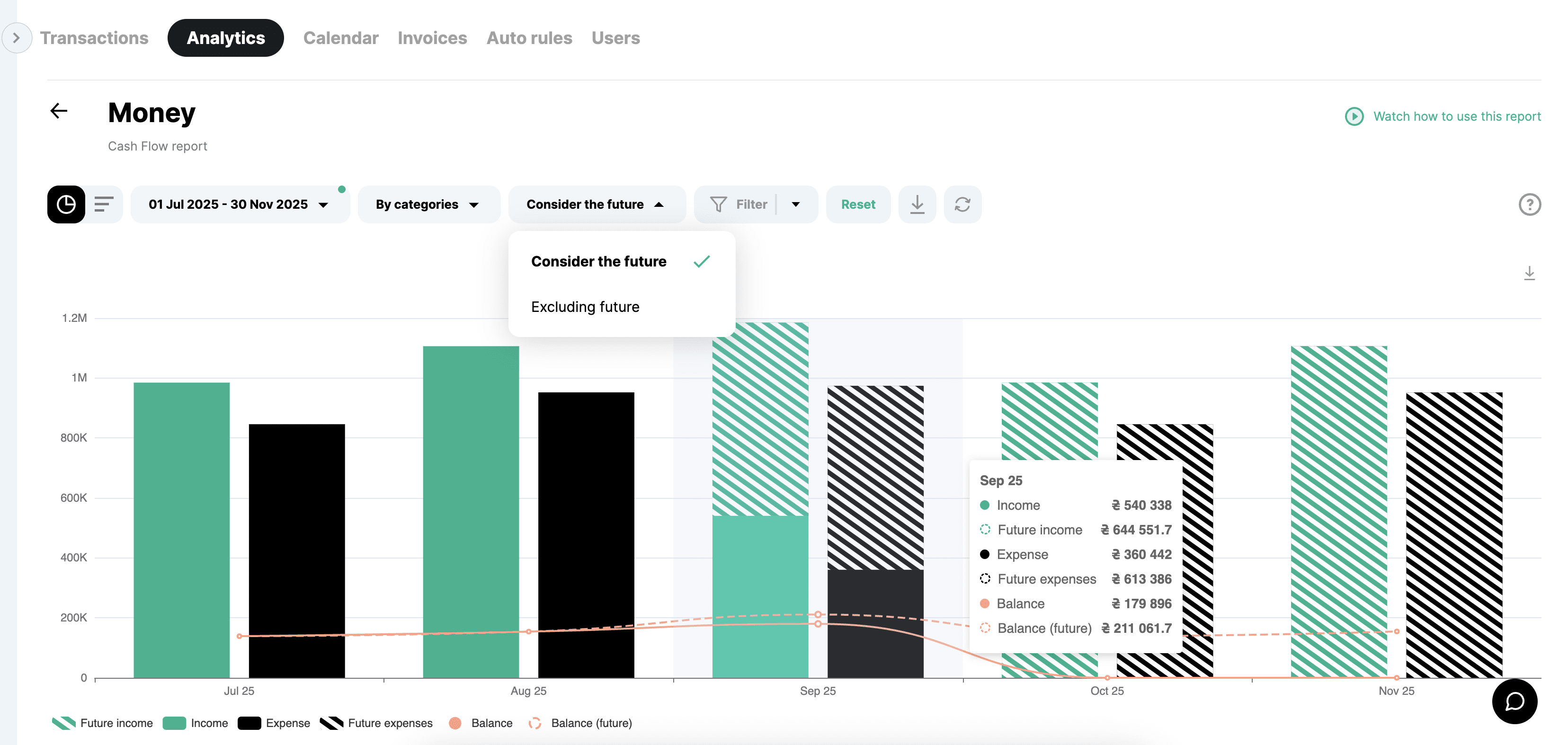
The analysis process in Finmap takes place in the Analytics section, where all the main financial reports are collected.
Here, you can not only view standard dashboards but also create custom reports based on saved filters — by categories, counterparties, projects, or periods.
In particular, the Cash Flow report allows you to track all changes in cash movement and see which income and expense sources have the greatest impact on its fluctuations.
This helps you quickly identify problem areas and make decisions based on accurate data.
Forecast
- Use the Payment Calendar to forecast 1–3 months ahead. Add all upcoming income and expenses to see projected balances by week or month — and avoid cash gaps in advance.
- Test different scenarios — basic, conservative, and optimistic: adjust the dates and amounts of planned transactions to see how it affects liquidity, net cash flow, and available balance.
- Create an income and expense plan based on scheduled payments and regularly compare deviations to keep liquidity under control and adjust the budget promptly.
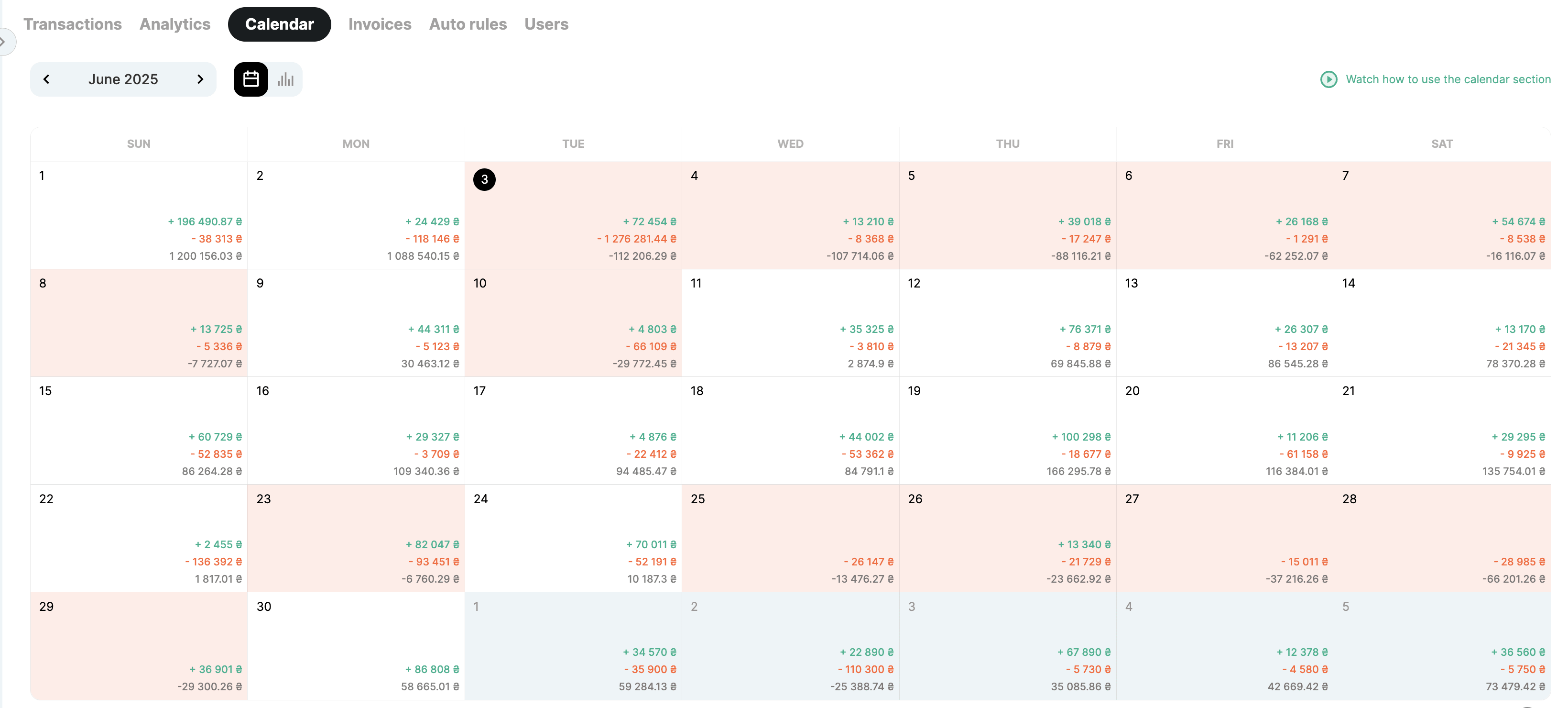
In Finmap, the payment calendar is generated automatically based on your planned transactions and shows the forecast of the company’s financial status.
It immediately indicates whether a cash gap is expected or, on the contrary, there will be a surplus of funds. The calendar allows you to assess the balance both for the entire business and for each individual account.
All changes — in dates, amounts, or transaction statuses — are instantly synchronized, so you can immediately see how adjustments will affect your future cash flow.
When cash flow is under control, a business gains the most valuable thing — predictability.
You no longer live from one inflow to the next, make blind decisions, or panic over sudden cash gaps.
Problem №2. Hidden Factors That Undermine Financial Stability
Sometimes financial instability arises not from declining sales or external factors, but from internal processes that quietly erode profits.
The cause isn’t always obvious: expenses grow faster than income, some money disappears into minor costs, and seasonal fluctuations only amplify the sense of instability.
To understand where exactly the business is losing profit, it’s worth paying attention to three factors that often go unnoticed but have a decisive impact on the financial outcome.
1. Seasonality: The Hidden Factor Affecting Revenue Stability
Your store, office, or café operates year-round — the assortment doesn’t change, prices stay stable, and clients remain the same. Yet one month there’s enough money, and the next you have to cover expenses from personal funds or a credit line.
The reason often lies in untracked seasonality.
It’s not always obvious: changes in season, holiday periods, days of the week, or even customer behaviour can create hidden demand cycles.
To avoid financial “swings,” seasonality needs to be identified and managed — by building reserves in profitable months and planning cash flow in advance.
In Finmap, seasonality is easy to track in the Cash Flow report — where the main dashboard clearly shows the dynamics of all financial activity and reveals seasonal trends.
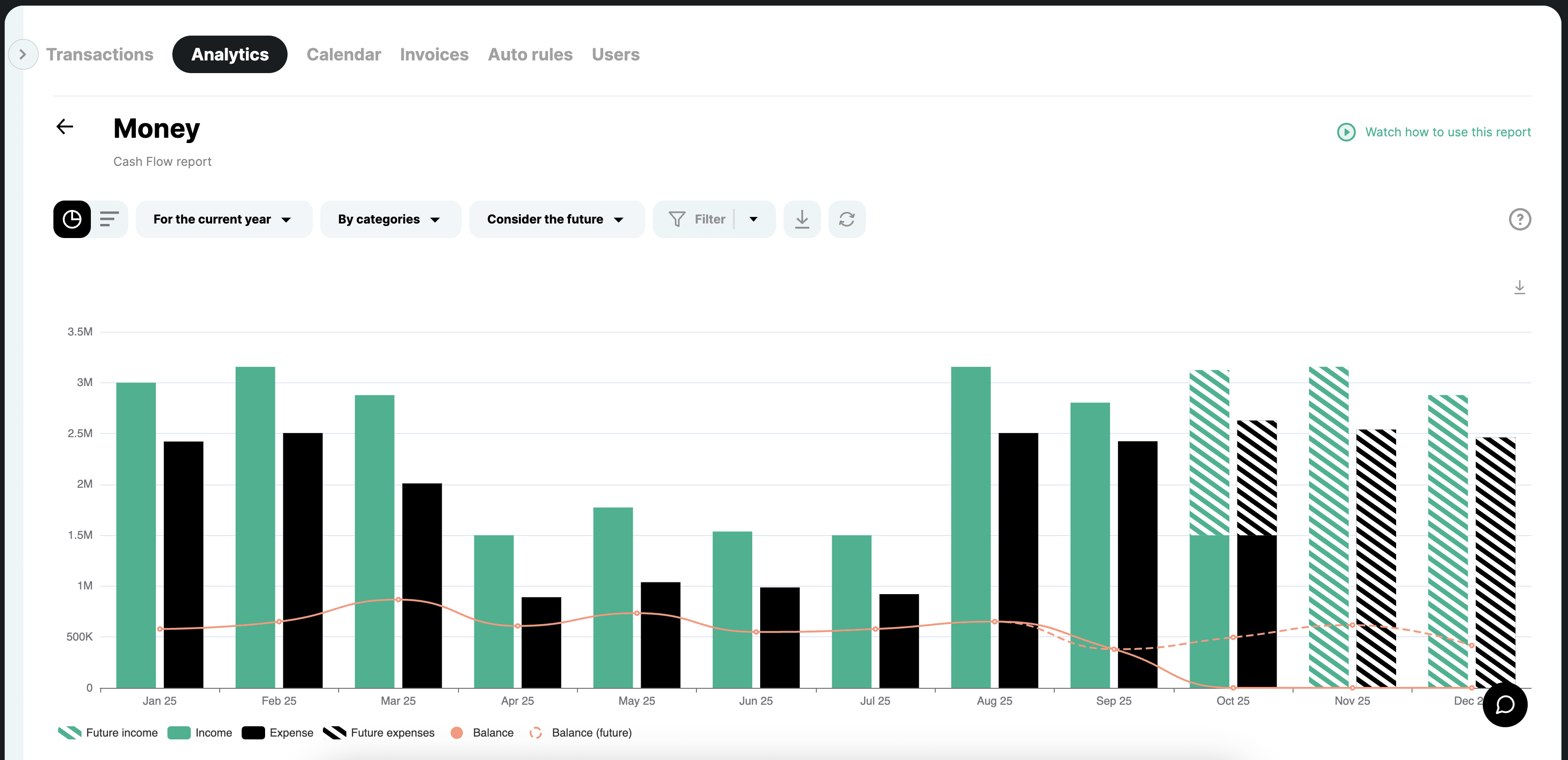
In addition to the graphical view, a tabular format is also available, where you can analyze demand changes by products, services, or specific categories in percentage terms.
If you want to dive deeper into how to analyze and manage seasonality — read the article «From Seasonal Slumps to Steady Profit: How to Earn All Year Round».
2. Hidden Expenses: Small Things That Cost the Business Its Profit
In local businesses, financial losses often hide not in large payments but in everyday small expenses that seem insignificant.
Coffee for the team, packaging, delivery, subscriptions, small purchases — none of them have a major impact individually, but together they make up a noticeable part of the budget that’s easy to overlook.
When these expenses aren’t recorded separately, the business loses the ability to control profitability and plan for growth.
To avoid this:
- Record all expenses — even the smallest ones. This gives you a real picture of where your money goes.
- Review your expense structure every month. This way, you’ll see which cost items are growing without objective reasons.
- Optimize small payments. Eliminate ineffective services, review suppliers, or consolidate purchases to reduce costs.
It’s the level of detail that opens up opportunities for optimization — allowing you to cut unnoticed expenses and free up resources for growth.

How to Track Expenses in Finmap:
- Use categories and subcategories for detailed tracking. This helps you see exactly where the money goes — from rent and advertising to office coffee.
- Record all expenses, even those that don’t go through the bank. Add cash transactions manually or via the mobile app to get the full picture.
- Set up automation rules even for small payments. Taxi rides, grocery purchases, or office supplies — everything will automatically be assigned to the right category with no extra effort.
Finmap reports show the dynamics of each expense item, helping you quickly identify which ones are increasing and which can be optimized to preserve profit and maintain liquidity.
3. Inefficient Pricing: The Negative Impact on Margins
Even a steady flow of clients doesn’t guarantee profit if prices don’t cover real costs.
Many local business owners set prices intuitively — based on competitors or customer expectations. As a result, some products or services generate minimal profit or even losses, while everything appears stable from the outside.
When the costs of materials, logistics, or labor rise but prices remain unchanged, margins gradually shrink.
To avoid this, pricing should be viewed not as a marketing decision but as a financial strategy.
Regularly analyze the profitability of each product or service category, review prices after cost changes, and check whether one area of the business is subsidizing another.
In Finmap:
- Use tags to separate expenses into direct and fixed costs — this helps you see the margin of each product or service and understand which areas actually generate profit.
- Compare the percentage breakdown of expenses by category between months to track whether the cost of purchases, rent, or services is increasing.
- Use analytics comprehensively — compare profitability and sales volumes with previous periods, identify trends, and look for opportunities to optimize your cost structure and increase margins.
Financial management is not only about income — it’s primarily about controlling the factors that quietly reduce profit.
Problem №3. Scattered Finances Due to Lack of Delegation
In local businesses, financial processes are often handled by those who are directly “on the ground” — administrators, cashiers, managers, or salespeople. They’re the ones who receive client payments, make purchases, record expenses, and handle cash.
However, when financial information is collected through messengers, spreadsheets, or voice messages, the owner inevitably faces chaos in reporting.
The lack of systematic delegation leads to:
- Time loss — you have to manually verify payments, clarify details, and consolidate figures from different sources.
- Errors and duplications — transactions are recorded multiple times or get lost entirely.
- Financial losses — incorrect or delayed entries distort the profitability picture.
- Lack of up-to-date information — the owner sees the situation with a delay instead of in real time.
- Risk of misuse — without clear roles and access levels, it’s nearly impossible to maintain financial discipline.
Without a proper delegation system, finances become a constant source of stress. The owner loses agility in decision-making, and growth prospects become minimal.
The solution is to delegate financial management correctly.
Instead of collecting data manually, add employees directly to Finmap and set flexible roles and access levels. This way, team members can independently record income and expenses only for their areas of responsibility — without having access to the company’s full analytics.
This gives the business three key advantages:
- Speed: data is entered into the system instantly, without manual forwarding.
- Accuracy: all transactions are recorded in one place, without duplication or errors.
- Control: the owner sees the full financial picture in real time, while employees work only within their area of responsibility.
How to Set Up a Delegation System in Finmap
Result: you no longer waste time manually compiling reports, and your team becomes transparently and responsibly involved in the financial process.
How Finmap Helped Dasha Katsurina Studio + Showroom Avoid Cash Gaps and Maintain Financial Control
Even in a small business, financial processes can be more complex than they seem.
When there are several sales directions, different product categories, and part of the team works in another country — it’s easy to lose control without a unified money management system.
That’s why the team at Dasha Katsurina Studio + Showroom decided to build their financial management in Finmap from the very beginning.
Dasha Katsurina Studio + Showroom is a space about women, style, and Ukrainian craftsmanship. Located in the very heart of Warsaw, it brings together works of Ukrainian designers and artisans — from clothing and jewelry to tableware and books.

It’s a place where you can feel young Ukrainian energy, enjoy a coffee, relax, and connect with like-minded people — a space free from prejudice, where creativity, authenticity, and humanity come first.
The team had already worked with the platform in their Ukrainian company, so it was only natural to continue using the same tool for their Warsaw branch — to maintain a unified structure for financial processes and reporting.
Before systematization, the team faced typical challenges of local businesses:
- cash gaps;
- delayed reports;
- lack of up-to-date information for decision-making.
These issues slowed down financial processes and made cash flow planning more difficult.
With Finmap, finances became transparent, structured, and accessible at any time.Thanks to the configured system of categories, accounts, and reports, the team can now see the full picture of cash flow and react quickly to changes.
Now we clearly see where the money is, how much has been spent, and on what exactly. It saves time and helps keep the business under control. — Viktoria, team member at Dasha Katsurina Studio + Showroom
Today, the financial system of Dasha Katsurina Studio operates smoothly:
- all data updates automatically;
- reports are generated instantly;
- the structure of expenses and income has become transparent.
This made it possible to avoid cash gaps, optimize financial processes, and focus on what truly matters — developing the brand and working with clients.
It’s important not to lose track of money and to see where it’s going. Without that, it’s impossible to understand how the business works. Financial management is the foundation of stability. — Viktoria, team member at Dasha Katsurina Studio + Showroom
Stability Begins with Systematic Management
In local business, every unit of money matters — that’s why it’s important not just to count money but to see the full picture.
When cash flow is under control, expenses are structured, and the team is involved in the process — finances stop being a source of stress and become a foundation for growth.
Finmap helps you build this system:
- unites all accounts in one place;
- automatically records income and expenses;
- provides real-time analytics;
- allows you to delegate financial management without losing control.
As a result, you gain not just numbers — but confidence and predictability in every decision.
Start today with Finmap so your business runs systematically tomorrow!
Frequently Asked Questions
1. Why is there not enough money even when sales are stable?
This can result from cash gaps, uncoordinated expenses, or an unbalanced cash flow structure. Often, money gets “stuck” in inventory, delayed payments, or small unnoticed expenses that accumulate over time.
2. How can I tell if my business has a cash flow problem?
The signs are simple: frequent lack of funds for daily expenses, delays in payments, the need to take loans to cover operating costs, or the absence of reserves for unexpected situations.
3. What should I do if several people manage finances and confusion arises?
You need to establish a clear delegation system: define who is responsible for what, set transparent rules for recording transactions, and centralize all data in one place to avoid duplication and errors.
4. How can I determine if my prices for goods or services are correct?
Regularly analyze your margins — the ratio of income to expenses. If costs increase (for example, due to suppliers or rent) while prices remain unchanged, margins decrease — and profitability drops even with stable sales.
5. What first steps will help bring financial order to a local business?
Start with the basics:
- unite all accounts in one system;
- record every transaction (cash, non-cash, small expenses);
- analyze the structure of income and expenses;
- create a payment calendar and a reserve fund.
This will form the foundation for financial stability and predictability.
.webp)
Financial Management for Gyms — Smartass Case Study | Finmap
How Smartass brought financial order and started planning for growth. A real case of automation, transparency, and scaling with Finmap.
Read
FREE
1.8k
7 min
20.09.2025
The money flow in gyms is usually intense: memberships, drop-in visits, personal training sessions, space rentals, sports nutrition sales — dozens of transactions every day.
Now add trainer salaries, equipment costs, utilities, taxes, and repairs — and you’ve got a financial whirlpool where it’s easy to lose control.
That’s exactly the kind of reality Smartass, a Kharkiv-based gym serving hundreds of clients daily, was operating in. But behind the scenes of this dynamic business, chaos was running the show:
There were gaps between the reports and reality. Cash was tracked separately. And that didn’t work for me at all — because I had zero visibility into the cash flow.
— Maksym, owner of Smartass Kharkiv
While the financial chaos was draining time and energy, the business couldn’t grow strategically. But everything changed when Maksym decided to systematize financial management, connected Finmap, and — together with a financial director — brought order to the numbers.
In this article, you’ll learn:
- how a gym owner went from reporting chaos to complete financial transparency;
- how automation helped plan dividends and staff bonuses;
- which insights reshaped the financial approach — and what’s next for the business.
Keep reading — and you’ll see how a real-life case proves: finance can be simple, and running a business can be calm and predictable.
.webp)
Why Manual Financial Tracking Was Holding Smartass Back
Every day, Smartass generated dozens of financial transactions — but the owner only saw fragments of the full picture. Cash operated on its own terms: administrators reported inconsistently, sometimes with delays, sometimes with mistakes. Maksym received scattered numbers, tried to reconcile them manually, and often found discrepancies between reports and reality.
Some things were accounted for, some were duplicated, some weren’t tracked at all. Cash was calculated separately.
— Maksym, owner of Smartass Kharkiv
To find out how much cash was in the register, Maksym had to message administrators, wait for their replies, and manually calculate everything on a calculator. Instead of a clear system — endless clarifications and manual math. It consumed time, created constant stress, and made it impossible to plan the business’s growth.
I had to calculate everything manually once a week or month, trying to figure it all out somehow. It was extremely inconvenient. Especially considering we already had a tool for this — and just weren’t using it.
— Maksym, owner of Smartass Kharkiv
As a result, he couldn’t forecast dividends or plan major expenses in advance. The business was operating reactively — responding to situations instead of proactively managing them.
Common Financial Challenges the Business Faced
What Triggered the Implementation of Finmap
Maksym admits that he had been unhappy with the financial situation for a long time — he just didn’t know who could fix it. The team was busy with their own tasks, and he didn’t have time to dive into the numbers himself. So the chaos dragged on for months — until the opportunity finally came to change everything.
When you offered to help fix it, I realized that in just a few months, we could turn it all around.
— Maksym, owner of Smartass Kharkiv
The key turning point was realizing that there was no need to search for someone responsible within the team or try to implement a system alone. There was a ready-to-use tool — and people who took over the process. This allowed the business to keep running while implementing changes in parallel, without placing extra burden on the owner or the team.
The first step was introducing a structured approach to cash tracking. Now all transactions — from received payments to cash deposits — are recorded in the system automatically, instead of being manually collected through messages from administrators.
Next, the team set up regular weekly reporting calls. Once a week, Maksym gets a complete overview: what’s been done, what’s in progress, and which payments are scheduled. This eliminated the need for him to check numbers daily or micromanage the staff.
Finmap began to be used to its full potential — not just for viewing balances, but also for forecasting expenses and income. Maksym received access rights to independently analyze the data and make changes when needed.
Another important improvement was the proper distribution of large expenses. Now, when the club purchases expensive equipment or plans technical maintenance, those costs are spread out over several months. This helps avoid sudden financial “dips” in reporting and allows for more accurate planning of cash gaps.
We started allocating expenses properly. Now we can plan technical maintenance for the whole year — instead of taking a hit in one specific month.
— Maksym, owner of Smartass Kharkiv
Triggers that Prompted Action
From Manual Calculations to a Structured System
Today, financial management at Smartass runs like a well-oiled machine. Maksym no longer spends evenings doing calculations or messaging administrators to find out how much cash is left at the front desk. All the information is in the system and updates in real time.
Now everything’s finally in order when it comes to managing cash. I see everything clearly in the system.
— Maksym, owner of Smartass Kharkiv
The process has become easy and predictable. Once a week, there’s a call to discuss what’s been done, which payments have been made, and what’s still planned. After that, the owner can calmly focus on growing the business — without worrying about daily control.
It’s really convenient for me because once a week we go over everything that needs to be discussed. I don’t have to remind anyone about anything.
— Maksym, owner of Smartass Kharkiv
Another major shift is the ability to forecast. Now Maksym can plan dividends, staff bonuses, salary increases, and large expenses in advance. The club stopped operating “after the fact” and started looking several months ahead.
In addition, the owner became more engaged in the financials: he analyzes statistics, reviews performance metrics, and adjusts data himself. This helps him make informed decisions — and feel in control of the business.
How Finmap Transformed the Club’s Financial Processes
Insights for Entrepreneurs
Maksym’s experience revealed several key lessons that can benefit any business owner.
First, he realized that the biggest problem isn’t the lack of money — it’s the lack of understanding where the money is going. When data is incomplete or chaotic, every decision becomes guesswork instead of a controlled process.
Secondly, he became convinced that automation relieves the lion’s share of operational burden. Now, instead of constant clarifications and manual calculations, the team follows a clear process — and Maksym receives all the summary information in a convenient format.
Thirdly, he saw that financial management isn’t a luxury for large companies — it’s a basic necessity for any business with daily operations. Forecasting brings confidence and allows for strategic decisions, rather than constant firefighting.
“The most valuable result is that I see the result,” — says Maksym, emphasizing that the true value of financial management lies in witnessing real changes, not just pretending to have control.
What Financial Order Brings to Your Business
Business Planning and Scaling
For Maksym, implementing financial management was not the end point, but just a starting platform. Now that all the basic processes are in place, he is moving to the next stage — deep financial planning.
What lies ahead is creating detailed budgets several months in advance, to forecast expenses and income, identify potential cash gaps, and avoid unpleasant surprises.
Now I can forecast the bonus system, pay rates, and salary increases with more confidence.
— Maksym, owner of Smartass Kharkiv
The club plans to optimize its bonus programs for staff, making them fairer and more transparent. This will not only help retain top trainers but also motivate the entire team to deliver results.
Future plans also include scenario analysis: what happens if rent or equipment costs increase, how the situation changes with more clients. This will enable the business to be managed not just at the moment but with a clear long-term strategy.
Action Plan for Further Business Growth
The implementation of systematic financial management became a true turning point for Smartass.
The business no longer lives from one report to the next — it plans, forecasts, and looks confidently into the future.
Maksym got rid of chaos, manual calculations, and endless clarifications within the team. Instead, he now has a transparent system that shows the real state of affairs, tells him when and how much can be spent or taken as dividends, and enables him to run the business — not just react to it.
Yes, of course I can recommend Finmap!
— Maksym, owner of Smartass Kharkiv
This case proves: financial management is not unnecessary bureaucracy, but the key to growth and business stability. It gives the owner a chance to free their mind from small details, focus on development, and finally feel in control of their business.
If you recognized your own business in this story — it’s time to bring order to your finances. The sooner you see the full picture, the faster you’ll be able to make decisions that lead to profit and scaling.
Frequently Asked Questions
1. How do I know if my business needs financial management?
If you can’t see the full picture of your cash flow, reports don’t match reality, and you have to count the cash manually — it’s already a signal that it’s time to systematize your finances.
2. How long does it take to implement financial management like in Smartass?
In Maksym’s case, the first results appeared within a few weeks, and full reporting order was established in a few months.
3. Does the business owner have to manage Finmap personally?
No, the owner gets a transparent system and access rights to see the big picture. Routine tasks are handled by a financial manager or administrators.
4. What if the business has a lot of cash transactions?
These businesses benefit the most: cash is automatically tracked in the system, and there’s no need to message employees or do manual calculations daily.
5. Does financial management help with planning and forecasting?
Yes, that’s one of its main benefits. At Smartass, they now forecast expenses, plan dividends, and even structure the team’s bonus system months in advance.
.webp)
Financial Management for Beauty Business: Budgeting Guide — Finmap
How to manage finances in a beauty salon or spa: budgeting, cash flow control, and profit tracking. Practical guide with tools for beauty business owners.
Read
FREE
1.1k
12 min
20.08.2025
Cash gaps, delayed payments to cosmetics distributors, not enough money to pay stylists, chaotic use of cash from the register — this isn’t the exception, it’s the daily reality for many salons where financial management isn’t a priority.
There’s no point in finding comfort in the fact that “everyone’s like that.” Successful salons prove the opposite: when finances are managed properly, profit, growth, and peace of mind appear.
Together with leading beauty industry experts Alina Tymoshenko and Nataliia Honcharenko, we identified three of the most common problems — and their solutions will help you regain control over money, avoid typical mistakes, and finally see your real profit.
Read to the end if you want to:
- see the full financial picture of your salon;
- anticipate cash gaps instead of constantly plugging them;
- delegate financial management without losing control;
- and start scaling — from a place of order.

Problem #1: You Don’t Know How Much Money Your Business Actually Has
As a business owner, can you answer this: how much money does your salon have at its disposal right now?
If instead of a clear number you start scrambling — checking banking apps, counting the cash in the register, messaging your team, trying to remember what was supposed to go through the POS — then this issue is already deeply rooted in your business processes.
The reason is simple: your money is scattered. Some is on business accounts in different banks, some on personal cards, some in the cash register, and some in the hands of your stylists.
How mixing personal and business money destroys your financial system.
This kind of setup leads to an even bigger problem: mixing personal and business finances.
The first — and most painful — mistake is mixing personal and business money. When one cash register is used to buy everything from studio supplies to groceries, or the day’s earnings are instantly spent on personal needs. As a result, by the end of the month, there’s no way to see a real picture of your income and expenses. — Alina Tymoshenko, mentor and author of educational programs for beauty entrepreneurs
Without a clear financial system, the owner uses any available account — whether it’s the company account or a personal card. It may feel flexible, but in reality, this approach undermines control and stability.
What this leads to:
- You can’t accurately assess the profitability of the business — injecting personal funds masks real losses.
- The business becomes dependent on the owner's personal finances — instead of evaluating financial efficiency.
- Expense tracking becomes messy — personal purchases can be misclassified in reports, skewing analytics and complicating tax reporting.
- You can’t build a financial cushion or plan investments — because there’s no clearly separated company cash flow.
- It increases financial anxiety and burnout — you don’t feel stable, even when revenue is coming in.
How to Bring All Your Finances into One System
To run your business based on numbers, you need to start with the basics — a complete list of all the accounts your salon uses. Without this, any kind of financial tracking is guesswork, not reality.
That’s why the first step to financial management in Finmap is to create a clear account structure and get the full picture: how much money you have, where it is, and what part of it is actually available for business use.
Separate business accounts are not a formality — they reshape your mindset as an owner.
Make it a rule: separate your personal and business accounts — and use them accordingly. For example, dedicate one bank or card for personal spending only, and another exclusively for business operations. Don’t mix them. Even if it’s “just convenient to transfer quickly from your personal one.”
This simple habit:
- creates a clear boundary between your life and your salon’s finances;
- reveals the true profitability of your business — without distortions;
- reduces stress by stopping you from constantly covering business costs out of your own pocket;
- enables data-based financial analysis, not intuition-based decisions.
Without clear separation between personal and business accounts, there is no real financial control — only the illusion of it. Finmap helps turn chaos into a manageable system from day one.
Problem #2: Unpredictable Cash Flow
You might be tracking daily revenue and have a rough idea of your expenses. But if you’re not planning and forecasting your cash flow ahead of time, you’re heading straight into a cash gap.
The core issue is this: income is always uneven, while expenses are constant. Without a structured financial system, the money you need simply might not be there when it’s time to pay.
What it means in practice:
- You have no clear idea how much money will be available in a week or two.
- Salary and rent payments are at risk, because decisions are made without analysis.
- Purchases happen randomly, without accounting for high and low activity periods.
Salon owners often overspend on inventory — ordering too many supplies in advance or buying things that aren’t critically necessary, without analyzing stock levels. These expenses add up and eat into the profits. — Alina Tymoshenko, mentor and creator of educational programs for beauty entrepreneurs
Cash Flow Is More Than Turnover — It’s the Key to Seasonality
Yes, beauty businesses also experience seasonality. For some, it’s a spring peak. For others — autumn. For many — the holiday rush in December. But if you don’t track and analyze your income and expenses over time, you simply won’t see the pattern.
In Finmap, it’s visible from the very first chart in the Money report — the monthly business dynamics help you quickly identify which months are the busiest.
This allows you to:
- Plan your team’s schedule in advance.
- Purchase supplies ahead of time.
- Balance workload and prioritize tasks for your team.
- Forecast potential cash gaps and avoid last-minute emergencies.
- Build a system of promotions or gift certificates to boost revenue during low seasons.
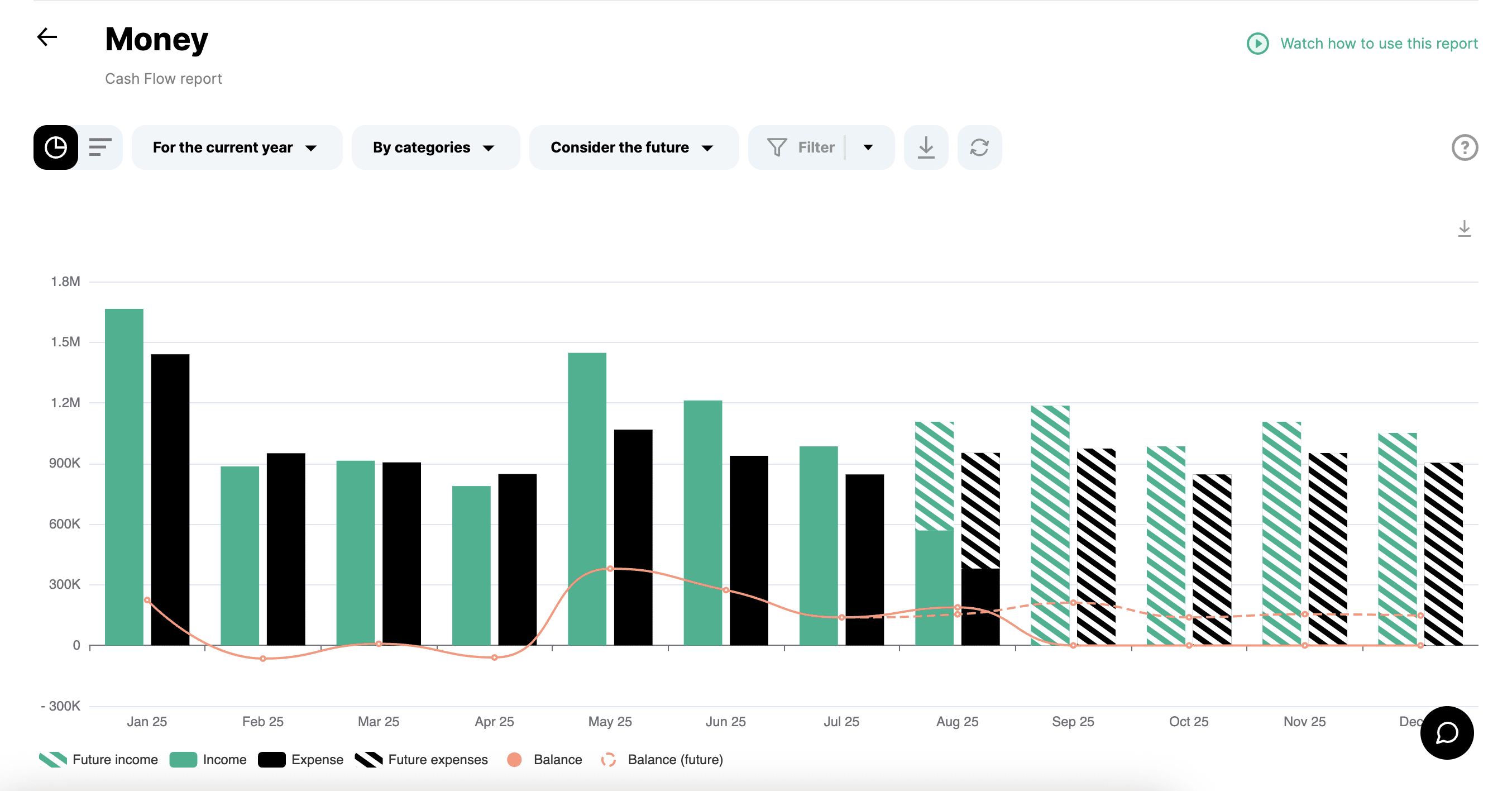
A plan isn’t just a formality — it’s confidence. It’s the confidence that at the most critical moment, you have everything under control — not running out of hair dye or supplies during the busiest booking season.
A Financial Safety Cushion Is the Foundation of a Stable Business
Another key benefit of tracking your cash flow is the ability to build a reserve fund.
The most common issue? A lack of financial safety cushion. Many studios operate month to month, and even after years in business, they remain vulnerable: any unexpected expense (equipment breakdown, sudden rent hike, or force majeure) can throw everything off track. — Alina Tymoshenko, mentor and author of educational programs for beauty entrepreneurs
When you clearly see cash surpluses in certain periods, you can intentionally set some of that money aside. Because the difference between running a business with a financial cushion and without one is massive:
Download the Checklist “Is Your Business Financially Secure?”
Money Management: How Finmap Helps You Control Your Cash Flow
So, after gathering all your accounts into a single system, the next step toward financial order is managing your cash flow — tracking the actual movement of money both daily and in a projected mode.
How to do this in Finmap:
- Sync your accounts: transactions will be automatically pulled in from integrated banks, or you can import them or enter them manually if you work with cash.
- Tag categories for each transaction or create auto-rules so expenses and income are automatically assigned to the right line items.
- Add all planned payments and expected income — rent, salaries, subscriptions, gift certificates, etc.
- Use the payment calendar to see exactly when money is needed and whether you’ll have enough to cover expenses.
- Review your cash flow reports weekly — analyze actual balances, seasonality, and business dynamics to make timely decisions.
Finmap turns chaotic money flows into a clear system. Now you can see what’s coming — and act ahead of time. This isn’t just reacting to financial issues; it’s systematic business management.
But even if you spot seasonality and plan your finances — that’s still not a guarantee of order. Because as long as all decisions, payments, and records are on your shoulders — you are the system.
And a system that depends on one person is always vulnerable.
Problem #3: You’re Not Delegating the Tasks That Drain Your Energy
Expectation: you have your dream business, successful and running on its own.
Reality: you’re its main engine, its core process, and the only guarantee of order.
Beauty salons are often born from talent and vision. From the desire to create something beautiful, something special. But as soon as clients, a team, and expenses appear — that dream turns into responsibility.
The owner quickly shifts from a creative role into:
- the lead stylist (because no one else does it better),
- the receptionist (because someone canceled, and the schedule still needs to be filled),
- the marketer (because reels need to be posted daily),
- the buyer (because supplies need to be found, ordered, and received),
- the decorator and logistics manager (because that new shelf has to be bought and installed),
- the HR manager (because it’s up to you to choose who joins your team),
- and even the cleaner (because you can’t walk past a messy workspace without fixing it).
It’s not the finances that cause problems — it’s ignoring them.
Finances don’t call, don’t message you on Viber, and don’t wait at your door with complaints. So among your daily tasks, they’re always postponed. First, the client, the post, the order, the schedule, the team... And the finances stay in your head, in scattered notes, in empty spreadsheets.
But that’s exactly how chaos begins. That “later” turns into a cash gap, missed salaries, and uncertainty about tomorrow.
A business doesn’t grow from intuition. It grows from structure. And the first step toward growth is freeing up your time and attention. Start with what matters most — delegating financial management.
How to Delegate Financial Management in Finmap
In Finmap, you can delegate parts of your financial processes to others without losing control. There’s a Users section where you can add everyone involved and set flexible access rights — from full access to limited roles (such as access to a single account or permission to enter data without seeing analytics).
And if you don’t yet have a financial specialist on your team — use Finmap AI Copilot. It will generate a clear report, highlight weak points, suggest what to do next, and even warn you about risks you might not notice on your own.
Remember: financial management isn’t just another task — it’s the foundation of a stable business. To grow, you need to delegate, and Finmap gives you the ability to offload part of the routine without losing control.
Because your role isn’t to carry everything yourself — it’s to manage a system that works for you.
How to Avoid Financial Mistakes in a Beauty Salon: Advice from Nataliia Honcharenko
Nataliia Goncharenko is a bestselling author for beauty entrepreneurs and founder of The Concepts Beauty Business School. She firmly believes that financial management is not just an Excel spreadsheet — it’s a full-fledged business culture.
Without knowledge, discipline, and the right focus, even a profitable salon can end up just breaking even.
We asked Nataliia to share key tips that will help you take control of your finances.
1. Start with discipline
Debt, cash gaps, lack of funds for salaries — these aren’t the root causes of problems, but their symptoms. The real issue is that the salon lacks even basic financial management. And deeper than that — it’s the lack of discipline.
In the beauty industry, it’s often entrepreneurial discipline that’s missing. When an owner regularly takes money from the cash register for personal needs, it’s not a mistake — it’s a conscious decision. They choose a cash gap over stability, delayed salaries over team loyalty, and debt over growth.
Discipline is not a talent or education. It’s a personal choice you have to make every day if you want your business to survive and grow. — Nataliia Honcharenko, founder of the international business school The Concepts Beauty Business School
2. Separate the payroll fund as its own category
One of the biggest mistakes in salon financial planning is ignoring the payroll fund (PF) as a separate expense. If you pay your team a fixed percentage of revenue, the PF grows along with your income. And if the percentage is flexible — increased revenue doesn’t guarantee profit at all.
The payroll fund shouldn’t scale directly with revenue. It’s a strategic expense category that needs separate control. — Nataliia Honcharenko, founder of the international business school The Concepts Beauty Business School
Start treating the payroll fund as an independent expense category. This will allow you to realistically assess the profitability of your services, manage profits, and see where the money is going.
3. Focus on marginal profit first
Average ticket size is a metric that doesn’t give a full picture of your salon’s financial health. What does give a true picture is marginal profit — the amount left after subtracting variable costs from each service or product. This is what covers your fixed costs and generates profit.
Why marginal profit matters:
- You can see how much money each service or product actually contributes to covering the salon’s expenses;
- You get data to manage variable costs;
- You can apply dynamic pricing and build well-balanced promotional offers;
- You stop setting prices blindly and start factoring in profitability and market realities;
- You can answer the key question: what must the service be like so we can sell it at this price?
Please don’t include a made-up portion of fixed costs in your variable cost calculations. And don’t multiply consumables by 2–3–5 — that’s a myth that’s spread across the industry. If you want to learn how to calculate things correctly — consult professionals, not social media advice. — Nataliia Honcharenko, founder of the international business school The Concepts Beauty Business School
Financial stability in a salon starts with simple steps.
You don’t need to become an accounting pro overnight — it’s enough to take responsibility and be open to learning. Because it’s the systematic approach to money that separates the salon that just survives from the one that grows and becomes truly profitable.
Money under control — business grows
If you recognized your own problems in this article — that’s already the first step toward change. Next comes systematizing your finances, organizing cash flow, and finally seeing your actual profit.
Because having the best stylists, a line of clients, and a stylish interior — that all matters. But it’s accurate financial management that gives a salon stability, profit, and confidence in the future.
Finmap is your control system that:
- unites all accounts, cash registers, and expenses in one place;
- shows how much profit each service and specialist brings;
- warns you about cash gaps — before they happen;
- helps form a payroll fund and plan out payments;
- reveals where the money is disappearing — and what to do about it;
- lets you delegate accounting while keeping full control in your hands.
If you want your salon not just to function — but to generate profit — start with financial management.
Try Finmap and bring beauty to your finances!
Frequently Asked Questions:
1. Why do I need financial management if everything in the salon seems stable right now?
Because “stable” is not the same as “profitable.” Without systematic management, you don’t see where money is leaking, which service is truly profitable, or whether you’ll have enough for next month’s payroll.
2. How can I tell which services or specialists generate profit, and which ones only create expenses?
You should track each area separately: record income and expenses for each service or specialist individually. This will help you see what’s working efficiently and what needs adjustment or optimization.
3. What happens if I still mix personal and business money?
You won’t be able to accurately assess the profitability of your business. Personal spending, cash withdrawals, and impulsive purchases distort the picture. Separate accounts and clear division help you see how much the salon actually earns and where the money goes.
4. Who should manage the salon’s finances? Does it have to be a financial specialist?
Not necessarily. At first, you can manage it yourself or delegate to an administrator, financial assistant, or accountant. The main thing is a clear system, consistency, and understandable rules for everyone involved in the process.
5. What if I don’t want administrators or specialists to see all financial information?
That’s totally fine. You should configure access rights so that each person sees and handles only what’s within their responsibility — for example, recording petty cash expenses or working only with their own account. This allows you to delegate some tasks while keeping control in your hands.

Finmap for Retail: Full Control Over Cash Flow, Profitability, and Growth
This article outlines the key financial challenges faced by retail and e-commerce businesses — and shows how Finmap helps solve them through proper financial management.
Read
FREE
1.8k
15 min
25.07.2025
You’re selling every day: website, Instagram, marketplaces. Money is coming in — but every day you’re asking yourself the same question: “How much is my business actually earning?”
Sales are growing, turnover is increasing, yet finances remain unstable despite this growth. One day there’s not enough money for advertising, the next — not enough for inventory. Instead of a clear financial picture, there's chaos and confusion. Is your business actually making money or just staying afloat?
In retail and e-commerce, mistakes are costly.
You offer a discount but forget to factor in logistics — and you’re operating at a loss.
You launch an ad campaign but overlook expenses — and your profit vanishes.
Without a clear financial picture, decisions become guesses. And guesswork means a risk of bankruptcy.
.webp)
Common Financial Problems in Retail and E-commerce
You’re constantly making dozens of decisions: how much to invest in advertising, when to pay suppliers, which product to order. But without a clear financial system, these decisions are almost always made blindly.
Here are 5 common problems that hold businesses back from scaling:
1. No Unified Financial System
Multiple business accounts, acquiring, marketplaces, cash on delivery, cash — your financial data is scattered across various dashboards and spreadsheets.
If this data isn’t consolidated in one system, you have no real picture of how much money you actually have, what income is expected, what’s already spent, and what should still come in.
Consequences:
- Every time you check your balances, it feels like a full audit, draining your time and nerves. Instead of managing the business, you’re searching through Excel files and online banking accounts.
- Your financial manager or accountant lacks up-to-date information. This can easily lead to exceeding turnover limits, additional taxes, or refunding clients.
- Calculation errors cause cash gaps, late payments, missed purchases — or funds get blocked on an account and can’t be used when needed.
The owner shouldn’t be spending time manually aggregating data — they should see the full financial picture in two clicks. That’s the foundation of effective management.
2. It’s Unclear What Actually Generates Profit
Most e-commerce and retail companies only know their revenue figures. But which product is actually profitable, which channel brings margin, and which one just burns resources — is usually not tracked.
According to a PwC Strategy report:
Around 50% of products in a typical sales portfolio generate less than 5% of gross margin.
Consequences:
- You’re selling a product that seems profitable or popular but is actually killing your profitability.
- Scaling becomes hard — you don’t know which products are worth promoting.
- Advertising budgets go to campaigns that don’t deliver meaningful returns.
It doesn’t matter how much you sell. What matters is how much you earn from each item. Your decisions should be driven by the margin on products and channels.
3. Cash Gaps Due to Disorganized Settlements
In your business, you deal with dozens of contractors every day: suppliers, logistics companies, managers, freelancers. Each has their own payment terms: prepayments, partial payments, advances, 7/14/30-day delays.
But without a systematic approach to tracking these settlements, you lose control: you don’t know who still owes you money and who you should have paid yesterday.
Consequences:
- Cash gaps appear: you seem to have money in the account, but it can disappear the moment an angry supplier calls.
- You incur penalties, shipments get blocked, clients are lost.
- You have to “put out fires” with your own money — covering payments from your personal funds or on credit.
Financial relationships with partners must be under control. Every payment should be planned and transparent — otherwise, it’s not a business but a chain of chaotic reactions.
4. No Financial Planning
In most e-commerce businesses, money comes in only after the order is fulfilled.
But most expenses are regular and often require prepayment: you need to buy inventory in advance, launch ads, pay advances, cover delivery costs, handle returns, and so on.
Consequences:
- If you don’t plan when and how much money is coming in — sooner or later you’ll face a situation where there’s not enough cash on hand or in the account.
- Payments are made using credit or loan limits, which leads to extra costs.
- Profit becomes unpredictable — you’re never sure until the end of the month whether you’ll break even or not.
According to JPMorgan Chase, over 60% of businesses don’t even have a basic monthly cash flow model. How long do you think those businesses can survive?
Without financial planning, you’re not managing money — you’re constantly fighting the consequences of not having it.
5. Money Frozen in Inventory
One of the most common financial mistakes in retail and e-commerce is buying inventory without a financial rationale. Decisions are often made emotionally: “It’s a good price,” “It’ll sell in season,” “It doesn’t spoil — let it sit.”
But every batch of inventory is frozen money. And if you don’t know whether you can sell this volume, at what margin, and whether the profit will cover ads, shipping, packaging — it’s not an investment, it’s dead weight.
Consequences:
- Without calculating full cost and margin, you can easily stock up on products that look profitable, but after shipping, packaging, and fees — you’re basically giving them away for free.
- You can’t pay for what’s truly necessary — because your money is frozen in inventory.
- You can’t grow sales because you don’t know which products actually make money.
Every purchase should be guided by analysis: can we sell it, how much will we earn, and is this better than spending the money on ads or growth?
.webp)
These aren’t all the financial problems e-commerce and retail businesses face. But these are the most dangerous ones.
They eat into profits, block growth, and create ongoing instability.
If left unresolved, scaling won’t bring growth — only more chaos.
Why Having a CRM Doesn’t Mean You’re in Control of Your Finances
Many entrepreneurs mistakenly believe that if they already use a CRM, their finances are under control. Yes, a CRM is important — but it’s designed for managing sales, not money.
A CRM helps you sell — and that’s its core purpose. It:
- Tracks leads and customer inquiries;
- Shows sales stages and funnel progress;
- Helps manage your sales team;
- Calculates conversion rates, average check size, and KPI performance.
But it doesn’t answer the key financial question: is the business profitable?
A CRM doesn’t track real expenses — for advertising, delivery, packaging, salaries. It doesn’t know when marketplace payouts are due or when you need to pay a supplier.
It won’t show how much money you have, how much is blocked, how much you owe, or how much is needed to cover all obligations.
CRM is about who bought. Financial management is about what you earned.
And if you want to manage your money — not just record sales — you need a dedicated tool.
Finmap — Real-Time Financial Management
Finmap is an online tool for financial management that gives you a complete view of your finances.
Finmap gathers everything in one place, automates routine tasks, and shows you where the profit is — and where the expenses are.
This is not “accounting for the tax office” — it’s a tool for making managerial decisions.
For retail and e-commerce, this is critical: Cash flow is unstable, expenses are scattered, and data is stored in dozens of different sources.
No More Chaos: All Your Money — Under Control in One Dashboard
Finmap brings all your financial sources into one system: bank accounts, acquiring platforms, marketplace data, cash on delivery, and physical cash — everything in one place.
It also offers an open API, letting you connect your CRM or other tools so the system captures not just payments but also sales data automatically.
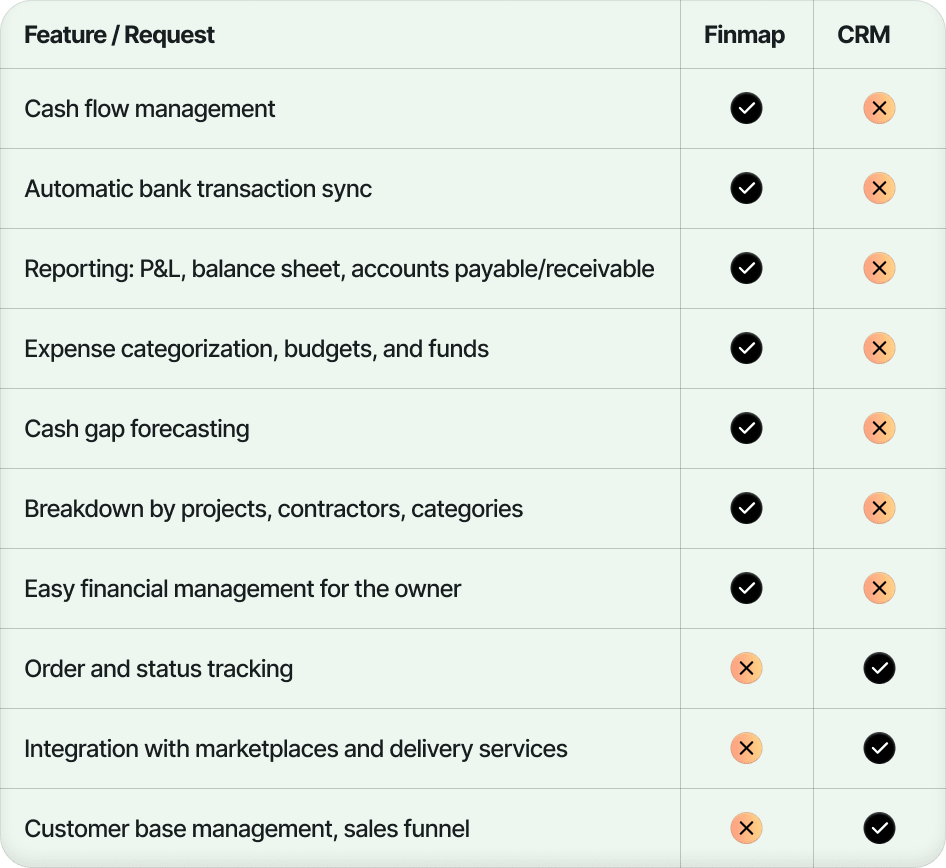
Result: At any moment, you see exactly how much money you have, where it came from, and where it's going.
This isn’t just convenient — it’s profit control.
Automate Your Finances — Manage the Business, Not Spreadsheets
Finmap helps you automate financial processes in just a few simple steps — without extra routines or constant manual control:

Result: All your data updates automatically. No errors. No delays. You finally free up time for strategic decisions, growing your business, and increasing profits — instead of chasing numbers.
“Projects” Report — See Profitability by Business Line
Want to know what actually brings profit: Sales from Amazon or Instagram? Wholesale or retail? B2B or dropshipping?
Finmap lets you break your business into separate “projects” — by sales channels, business lines, product lines, brands, or marketplaces.
And then see income, expenses, and profit by each one.
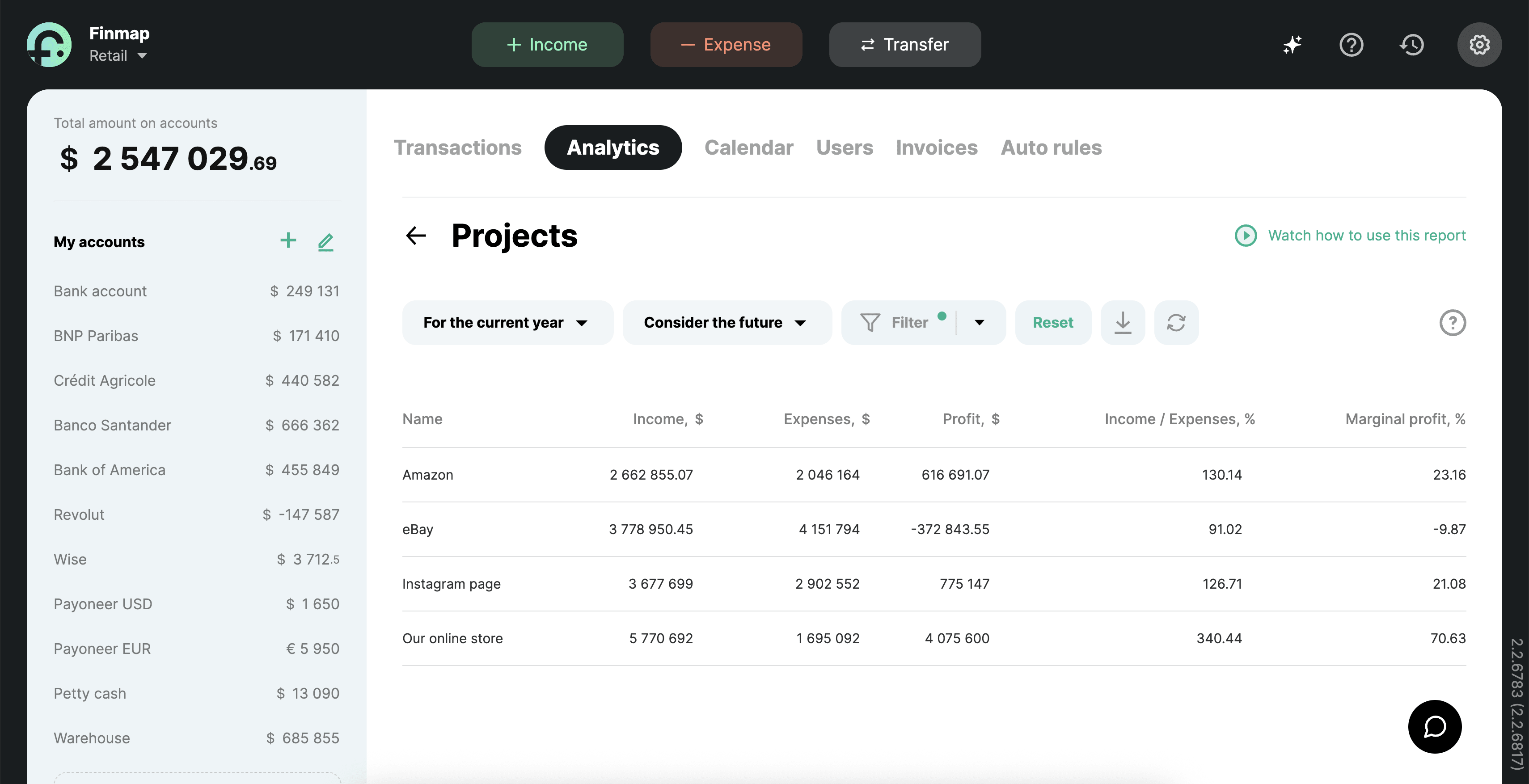
Result: You make decisions based on margin and profitability. You scale what works — and cut what drags you down.
Payment Calendar — Your Financial Planner
Tired of putting out fires?
With Finmap, you see all upcoming income and expenses day by day — and can spot potential cash gaps before they happen.

Result: You plan cash flow ahead of time, meet your payment obligations on schedule, avoid shortfalls, and manage your business proactively — not in panic mode.
Inventory in Money Terms — See Profit, Not Just Stock
You bought the goods but haven’t sold them yet. The money’s already gone — but the profit hasn’t come in.
Create a separate “Warehouse” account in Finmap, where you’ll track inventory movements in money terms, not just item counts.
Result: You see exactly how much you earn from the products you’ve sold.
You don’t confuse spending with assets — especially critical for businesses with large inventory balances.
Control Payables and Receivables — Avoid Cash Gaps and Losses
Many businesses lose money not because of low sales, but because they don’t get paid on time — or fail to track their own obligations.
Finmap lets you track every debt: who owes you, how much, and when it’s due.
And vice versa — who you owe, payment dates, what’s already paid, and what’s still outstanding.
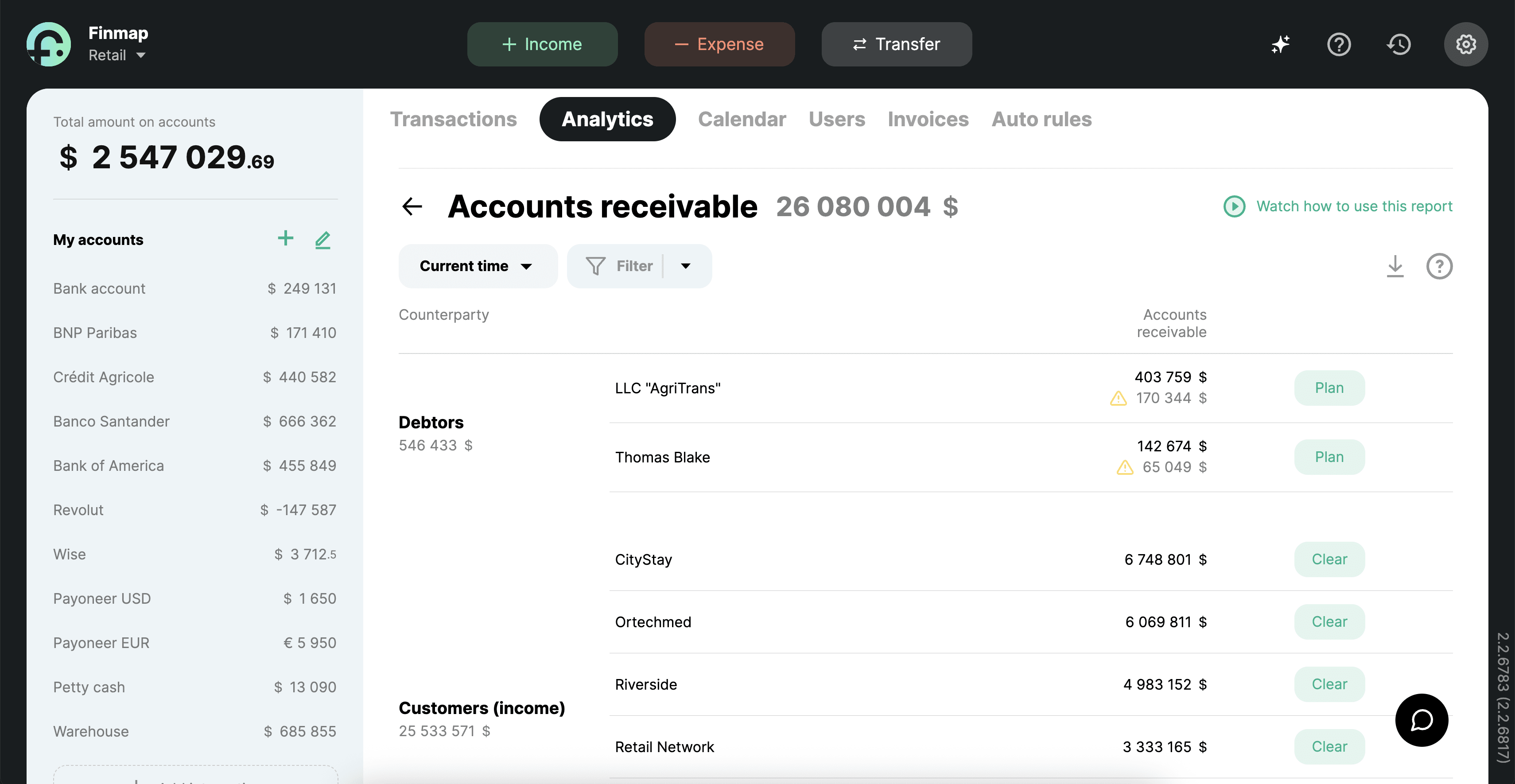
Result: All your receivables and payables are under control. No more forgotten payments, lost clients, or damaged reputation. You can forecast cash gaps, manage working capital, and know exactly what you can count on.
A Flexible Tool for All Your Needs
Beyond core features, Finmap easily adapts to the way your business works. You can:
- Track salaries and bonuses paid to your team
- Delegate routine tasks to employees using flexible access rights
- Analyze profitability by client, marketplace, or ad campaign
- Monitor how much each team member earns and spends
- Send invoices and track client payments

Result: You don’t just get accounting — you get a financial system tailored to your business. From day-to-day operations to strategic analytics — everything that affects your profits is under control in one workspace.
Finmap Client Case: From Financial Chaos to Strategic Management
Klebrig is a hypermarket of chemical products that repackages and sells chemical goods. They operate their own production of products for household and food industry use and deal with a large product catalog, regular procurement, and constant logistics costs.

Before implementing Finmap, their financial management was limited to Excel sheets. The accountant handled taxes, but the owner didn’t trust the overall financial picture.
It was only after the founder, Andriy, stepped out of daily operations and started tracking money himself that he discovered serious gaps: cash flow problems, no control over operating and working capital expenses, and inaccurate P&L analysis.
There were days when the money simply wasn’t there — but I knew it was supposed to come in. Managing money and actually seeing the big picture are two different things. — Andriy Femyak, founder of Klebrig
At first, they used Finmap just to track money and centralize all financial sources in one system.
But once Andriy explored it further, he realized that Finmap is a comprehensive financial management tool showing the full picture: income, expenses, working capital, and liabilities.
Initially, Finmap was just a payment tracker. But over time, it became an analytical system — helping us assess profitability, plan investments, and avoid financial mistakes. — Andriy Femyak, founder of Klebrig
The company built its financial system around three core components:
- P&L reporting — to assess profitability monthly and identify unprofitable areas
- Cash flow forecasting — to plan working capital and see when actual funds would be available
- Expense control — to structure costs across operations, procurement, and growth
As a result, financial decisions in the company are no longer made at random.
Financial decisions are no longer based on guesswork. The business sees not just what has happened — but what’s coming next: When the money will arrive, whether it’s enough for raw materials, and if there’s a reserve for investments.
That allowed Klebrig not only to stabilize finances — but to shift toward strategic financial management.
A word of advice from Andriy to other entrepreneurs:
Before you invest in anything, clearly separate what counts as operational expenses and what counts as working capital. Calculate full cost — including logistics, packaging, and fees. Without that, no investment will bring you profit.
Finmap: Financial Control for Retail and E-commerce
This isn’t just a convenient tool — it’s a mission-critical foundation for your business’s stability, growth, and profitability. Finmap:
- Brings together all income and expense sources into one system
- Automates financial management
- Shows profitability by product, sales channel, and business direction
- Helps forecast cash gaps
- Tracks business and product seasonality
- Controls receivables and payables
- Gives you the complete financial picture for confident decision-making
Finmap is your foundation for real profits and scalable growth.
With Finmap, you don’t have to guess where your money is — you know.
Launch your financial system today — and start earning, not just selling.
Frequently Asked Questions about Financial Management in Retail and E-commerce
1. We already have a CRM. Why do we need Finmap too?
A CRM manages orders — not your money. It doesn’t account for actual expenses, show cash gaps, or provide P&L reports.
Finmap answers the core question: Is your business profitable, not just selling?
2. We use Excel for everything. Isn’t that also financial management?
Not really. Excel means manual work, constant errors, and outdated info.
Finmap automates it all, syncs with your banks, and gives you real-time financial visibility — not “after-the-fact” reconciliations.
3. We’re a small business. Do we really need a system like this?
Small businesses often suffer the most from cash gaps and poor spending decisions.
Finmap isn’t about company size — it’s about control. Start small so you can grow with confidence.
4. We’re already profitable. Why add another system?
Profit without transparency is luck, not strategy.
Without control over cash flow, margins, and obligations, you can’t scale safely.
Even profitable businesses can burn out from one cash gap if they’re not planning ahead.
5. Can Finmap show which products and channels are profitable?
Absolutely. You’ll see profitability by product, channel, or marketplace — so you can double down on what works and cut what drains resources.
6. I’m not a finance expert. Will I even understand it?
Finmap isn’t made for accountants — it’s made for business owners.
Clean dashboards, clear reports, no jargon.
Your financial picture is just a few clicks away — so you can make smart decisions without getting buried in spreadsheets.
.webp)
The Secret to Increased Profit: How Financial Management Boosts Earnings
How financial managementcan help increase profits. Understanding the secrets of profitability: valuable tips for increasing income.
Read
FREE
2.7k
7 min
20.03.2025
You work tirelessly, your team gives 100%, revenue flows in, yet by the end of the month, there’s barely any profit left. If this sounds familiar, you probably suspect that the issue isn’t low sales but rather a lack of clear financial visibility. This is where financial accounting comes to the rescue.
It’s not just numbers in Excel or reports for tax authorities. It’s a financial analytics system that reveals where your business is losing money and how you can preserve and multiply it.
.webp)
Why Financial Management Matters More Than a Business Owner’s Intuition
Let’s look at a real case involving one of our clients — entrepreneur Yevhen, who successfully transformed his business and doubled his profit. He owns a law firm operating in multiple areas but, for confidentiality reasons, has requested not to disclose its name.
Like many business owners, Yevhen saw the overall profitability of his company but lacked a clear understanding of the financial performance of each individual segment. This became a critical issue when he considered scaling and expanding into new markets.
A thorough analysis uncovered an unexpected reality: out of five business areas, only two were profitable, one was breaking even, and two were operating at a loss. This raised an important question: how could he adjust his current strategies to reduce losses and improve business efficiency?
The solution was drastic:
- Eliminate the break-even segment and redirect the team’s resources toward developing profitable services, enhancing their effectiveness.
- Shut down one unprofitable segment since it showed no growth potential.
- Retain the second unprofitable segment because it played a strategic role in attracting clients to profitable services. However, to stop it from generating losses, Yevhen had to optimize expenses and rethink operational processes.
The results were immediate: after the reorganization, only three segments remained, yet the company’s profit doubled the very next month. And all this — without hiring more staff, making additional investments, or acquiring new clients.
This story once again proves that without financial management, it’s difficult to identify a business’s weak points. Accurate financial data enables informed decision-making rather than relying on intuition, which can gradually lead a company to bankruptcy.
Key Elements of Effective Financial Management
For financial management to truly help increase profits, it’s not enough to simply collect data — you must also interpret it correctly. A clear financial structure allows you to quickly identify problem areas, make well-informed decisions, and grow your business without unnecessary financial risks.
What are the foundations of effective financial management? Let’s break down the essential elements that make it work.
1. Unified Data System
Settlement and card accounts, cash in any currency, even cryptocurrency — all financial flows should be consolidated into a single system. This ensures that records reflect not only legal entities but also real cash flows and company wallets.
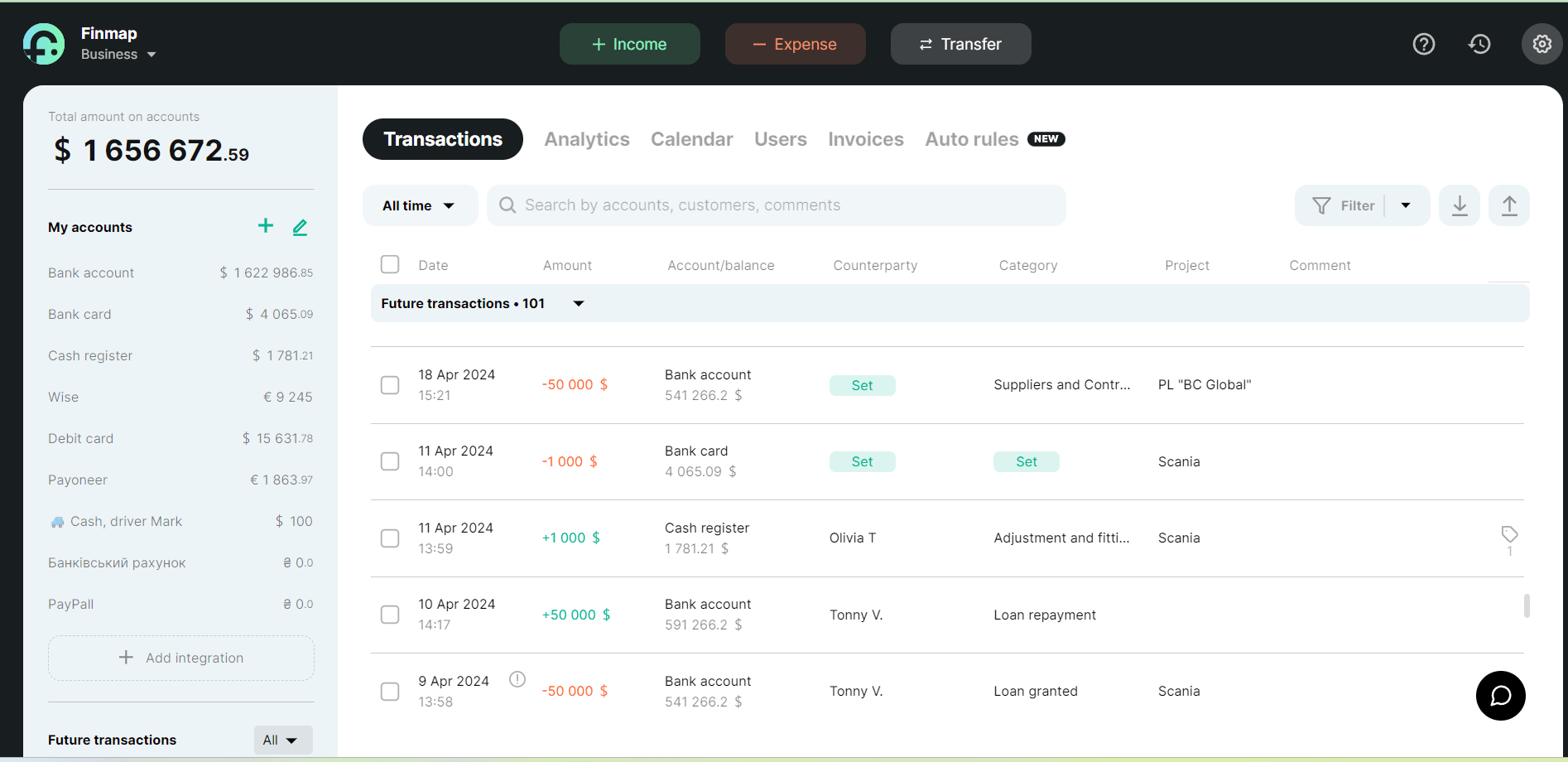
As a business owner, you shouldn’t have to guess how much money is in the business — you need to see it clearly and instantly. How much cash is available right now? What is the actual profit? Where is the money going? These answers should be accessible in one click — without chaotic bank statements and endless spreadsheets.
2. Standardized Data
Without a unified system for collecting and analyzing financial data, there’s always a risk of losing control over finances, which can lead to inefficient resource management.
What does data standardization include?
- Clearly defined responsibilities. Each team member should understand their role in financial management and be accountable for their segment.
- Strict reporting deadlines. Timely data collection and reporting are not just good habits — they are the foundation for making informed and timely decisions.
- Structured income and expenses. Without clear categorization, it’s nearly impossible to assess the company’s true financial standing.
- Defined business segments and projects. If revenue-generating areas aren’t distinguished, measuring their profitability becomes impossible.
- Consistent profit and cost calculation rules. Without clear criteria for cost allocation, depreciation, and other expenses, financial reports become vague and unreliable.
3. Clear and User-Friendly Analytics
To make effective management decisions, a business needs a clear financial picture spanning several months or even years.
It’s crucial to present this data in a convenient format — charts, dashboards, and visual summaries all on one screen, rather than scattered across chaotic, manually compiled spreadsheets.
This approach eliminates time wasted on endless number crunching and allows leaders to focus on strategic decisions that drive business growth. Without such a system, a business is essentially operating blindly.
4. Segmented Profit Calculation
Profit shouldn’t be calculated only at the company-wide level—it must be broken down by projects, business lines, product groups, and sales channels. Additionally, tracking margin and profitability for each segment is essential.
Only a segmented approach enables entrepreneurs to clearly understand why profits are declining and what needs to be adjusted to reverse the trend. Without detailed insights, businesses risk overlooking critical shifts in specific areas and expenses that could significantly impact overall results.
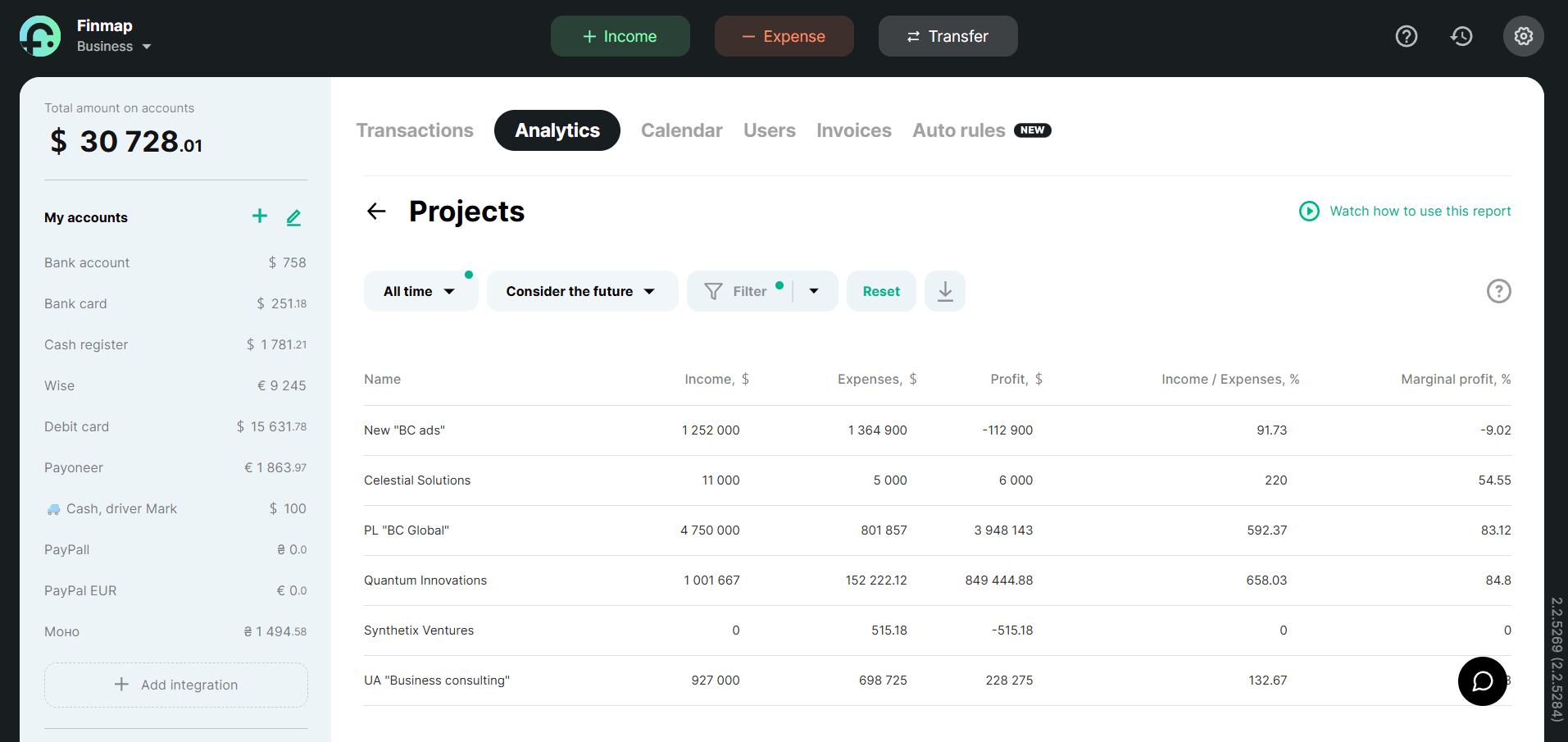
5. Calculated Break-Even Point
How much do you need to sell — daily, monthly — to reach break-even? Where is the fine line between profit and loss, and how many sales are required for your business to become self-sustaining?
These figures must be precisely calculated. Continuously monitoring them allows for timely strategy adjustments and swift responses to market changes.
6. A Fixed Income and Expense Plan
Imagine this scenario: tomorrow, you need to pay a contractor, but your account balance is just enough to buy some cookies for tea. In a week, you’ll receive a large payment, but in the meantime, the contractor bombards you with frustrated messages and threats to terminate the partnership.
This doesn’t mean your business is unprofitable — it’s a classic cash flow gap, where incoming and outgoing funds are out of sync, leading to a temporary shortage for covering operational expenses.
Why endure unnecessary stress and waste time on apologies?
To avoid these situations and prevent every payment from becoming a crisis, you need a reliable tool — a Payment Calendar.
This will be your trusted ally in managing cash flow and planning expenses to avoid financial pitfalls. You can track all income and expenses in a simple Excel spreadsheet or use an automated solution. This way, you’ll not only know how much money is coming in and when but also plan your spending regardless of circumstances.
Business isn’t just about taking risks — it’s also about anticipating them.
.webp)
In essence, financial management is a navigator that helps design and optimize long-term business strategies, set realistic goals, achieve them, and build a stable, profitable company.
Simplify the Process with Finmap
A simple online financial management tool like Finmap can make this process effortless and transparent.
With Finmap, you can:
- See all your business finances on one screen.
- Generate automated financial reports in just two clicks.
- Plan income and expenses effectively.
- Delegate routine financial tasks to employees.
- Maximize your business profits.
Start building a successful future for your company today!
.webp)
Innovative Path to Growth: The Success Case of Kukuruza Video Production Studio
The article describes the successful scaling of the Ukrainian company Kukuruza Video Production through process automation and the implementation of innovative solutions such as CRM, Finmap, and Notion. The use of banking integrations, flexible access systems, and automatic reports has helped the company to effectively manage its finances, increase productivity, and improve business transparency.
Read
FREE
1.6k
7 min
10.01.2025
Is it possible to scale successfully while keeping all records in notebooks and homemade spreadsheets? “Definitely not!” confidently answers Oleksandra Kulykova, founder and CEO of Kukuruza Video Production.
Scaling a business without process automation is like building without a foundation. This renowned video production studio proved it with their own example, implementing innovative solutions that not only save time but also optimize team operations.
How Kukuruza Video Production Combines Creativity and Efficiency in Their Work
Kukuruza Video Production is a Ukrainian company that creates animated content and videos for customers from all over the world. The company's clients include both big brands and local businesses. For example, they have worked with such well-known companies as Porsche, Lenovo, NEOLUX, Rozetka, and others.

In 2022, the team faced new challenges: large amounts of information required an integrated approach. Data on potential customers, active projects, budgets, milestones - all this needed to be structured for effective management.
This solution was implemented by the Ukrainian integrator CRMiUM, which combined all workflows into a single, unique ERP system. The process of customer acquisition and order fulfilment is now tracked holistically in the CRM, Notion and Finmap applications.
A logical question arises: if you already have CRM and project management, what is the need to use Finmap?
Integrations as an Effective Automation Tool
One of the key changes was the introduction of banking integrations, which allowed us to synchronise all payment systems in one programme. This has significantly reduced the time required to enter transactions manually, as now any movement of funds, especially receipts from customers, are immediately reflected in Finmap.
This information is automatically transferred to the CRM system, and from there to Notion, signalling to managers that they are ready to launch new projects.
One of my rules for sustainable development is to have the courage to experiment, take risks, and try new approaches. Don't be afraid to go beyond the standards. — Oleksandra Kulykova, CEO of Kukuruza Video Production
In her work, Oleksandra strives for innovation, while in finance she takes a pragmatic approach. Even when it comes to risky financial decisions, Finmap tools, such as the Payment Calendar forecast, help her understand how justified such a decision will be.
.webp)
Delegation and Flexible Access: The Key to Process Optimisation
American motivational psychologist Brian Tracy notes in his book Delegation and Management:
If someone can do a task 70% as well as you can, delegate it to that person. Free yourself up to tackle the tasks that only you can do.
This advice is relevant for all areas of business, and is especially important for financial accounting. After all, business owners often spend too much time and energy on routine payment processing.
Oleksandra and her team avoided this problem by using a flexible access system for each of their employees.
We created an account for each manager and gave them access only to the projects they are involved in. This is very convenient, because employees do not have access to fundamental information and focus only on the workflow for which they are responsible. — Oleksandra Kulykova, CEO of Kukuruza Video Production
This approach allows you to:
- Protect confidential information.
- Quickly analyse accountable funds.
- Monitor the status of accounts in real time.
Even contractors have access to only the necessary part of the data to set up a CRM system, without diving into financial information.
How the Projects Report Helps to Quickly Analyse Profitability
Each payment, whether it is automatically integrated through banking systems or added manually by the manager, is immediately recorded in the Projects report.
Thanks to the automatic calculation of project profitability, the company is able to analyse all orders in real time.
How does this help the business?
- Transparency to customers.
The company can reasonably explain how additional services or concessions affect the final profitability. This ensures trust and transparency in customer relations.
- Promptness of decisions.
The team sees the financial status of each project in real time, which helps to make strategic decisions faster.
- Management of additional services.
Changes that are not included in the contract are instantly reflected in the report, allowing you to respond and adjust your work in time.

Kukuruza Video Production's experience proves that each area of activity requires specialised tools that automate and simplify processes. Whether it's off-the-shelf ERP systems or customised solutions, it's up to you. But without a clear financial structure, success is impossible.
Choose Finmap as your reliable partner and focus your resources on developing and scaling your business. Technologies work for you — use them to their fullest potential!

How Finmap Helped LIBERT Save Over $8,000 Annually and Optimize Financial Management
Find out how Finmap makes financial accounting easier, even for consistently profitable companies.
Read
FREE
1.5k
10 min
10.10.2024
Proper financial management is a tool to not only make business transparent and efficient in the long term, but also to save resources. Why it is necessary to improve financial management even in a profitable company, read in this article.
LIBERT Is a Leader in Premium Transportation
LIBERT - company specializes in individual premium and business class transportation, offering a wide range of services to its customers. Their portfolio includes transportation of official delegations, mass transport events, as well as international transportation.
The key advantage of LIBERT is the highest level of service, with attention to every detail and maximum consideration of the client's wishes. Key aspects that ensure a solid reputation include:
- An individual approach to the route, taking into account all the client's requirements.
- Armored cars for maximum security.
- Speed and efficiency of transportation organization.
- High level of service and availability of English-speaking drivers.
- Full support of the trip with the organization of the necessary reservations and security.

The LIBERT company achieved success thanks to the scrupulous and responsible approach of its owner. Andriy Antonenko is attentive not only to customer service, but also to the organization of internal processes. A special emphasis on financial management helps the company to effectively manage finances, control costs and grow confidently.

Spreadsheets vs. Business: Why Manual Accounting Doesn't Work Anymore
Andriy started his business in 2008. He refused to conduct affairs blindly, without a clear understanding of how much money was spent and what payments were made.
For digitalization of business, the company used self-made spreadsheets all these years.
I studied financial literacy on my own. Order isimportant to me, especially in finance, so I immediately trained my subordinates to a clear reporting system. — Andriy Antonenko, owner of LIBERT
When financial management was kept on a monthly basis, the functionality of the tables seemed to be sufficient. But when at the end of the year more than twelve tables had to be compiled and a report issued, the time and nerves spent only burdened the owner. Over time, the tables multiplied, and although they provided a lot of information, it seemed impossible to qualitatively analyse and systematize them.
The next challenge was that at some point the control of the reports and the validation of all the formulas changed for the daily business of the owner.
If in the evening you do not check everything against the tables and do not additionally list all the results, or you miss a mistake somewhere, then tomorrow it will be impossible to untangle this tangle of data! — Andriy Antonenko, owner of LIBERT
Such checks took not only time, but also the resources of the owner himself, who should have dealt with more global issues.
Successful organization of financial management became impossible due to a number of reasons:
- Attempts to implement a CRM system did not give the desired results, because they did not cover even half of the company's business requests.
- Working in tables took too much time and didn't allow to quickly obtain complete information.
- The operations manager had a high workload, and reworked the norm of working hours.
How Finmap Changed the Approach to LIBERT Company Financial Management
Andriy learned about the Finmap service from a financial specialist who was putting his contractor's financial management in order. The financier organized the data using Finmap, and the speed of generating reports was impressive.
I decided to try Finmap as well. The system issimple and everything is clear. And the online meeting with the support consultant made it possible to customize the service exactly to my business format. — Andriy Antonenko, owner of LIBERT
Monitoring the Operation of Cars
In Finmap, it is convenient to track the results of the operation of the machines that Andrii started as projects. The system shows how much was spent on servicing each car and how much money was earned.
You can analyse revenue by car class and determine the most profitable or least profitable cars. In the service, it is possible to detail data also by type of services and even by individual clients.
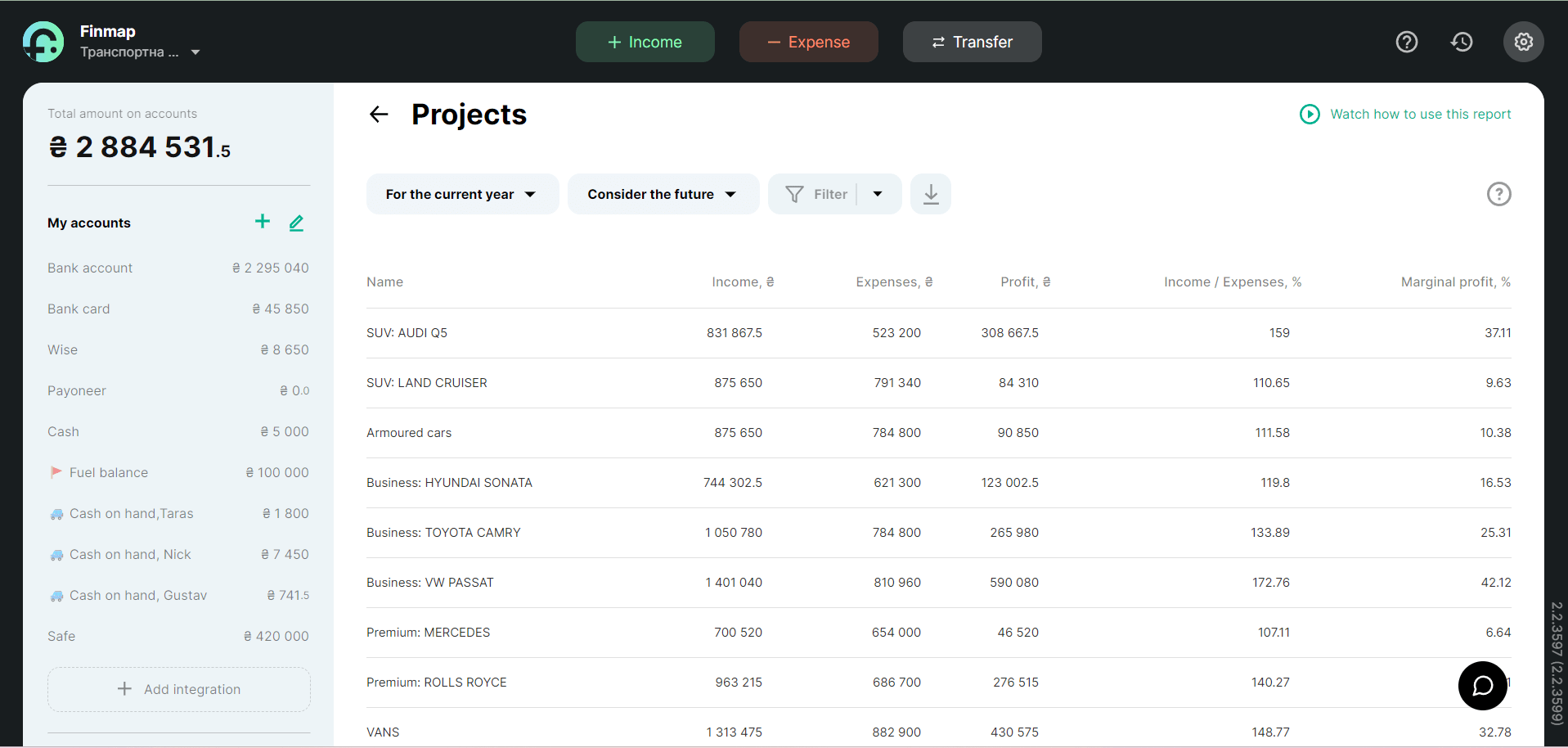
Control of receivables
In the LIBERT business model, the main indicator is not the amount of funds received from the client, but the number of services provided. Payments are usually made after the fact, at the end of the month, and accounting for all services and related expenses must be online.
The manager enters the issued invoices into the service in the form of Accounts Receivable, indicating the period when transport services were provided and the date when they are expected to be settled.
The owner only has to open the Debtor report in Finmap and check:
- Who has already paid
- Who has delayed payment and needs additional reminders
- What new invoices were issued
The Profit report helps to analyse this information from a different angle. After all, even in the first graph, the amount and the term for which the funds have not been paid are immediately visible.
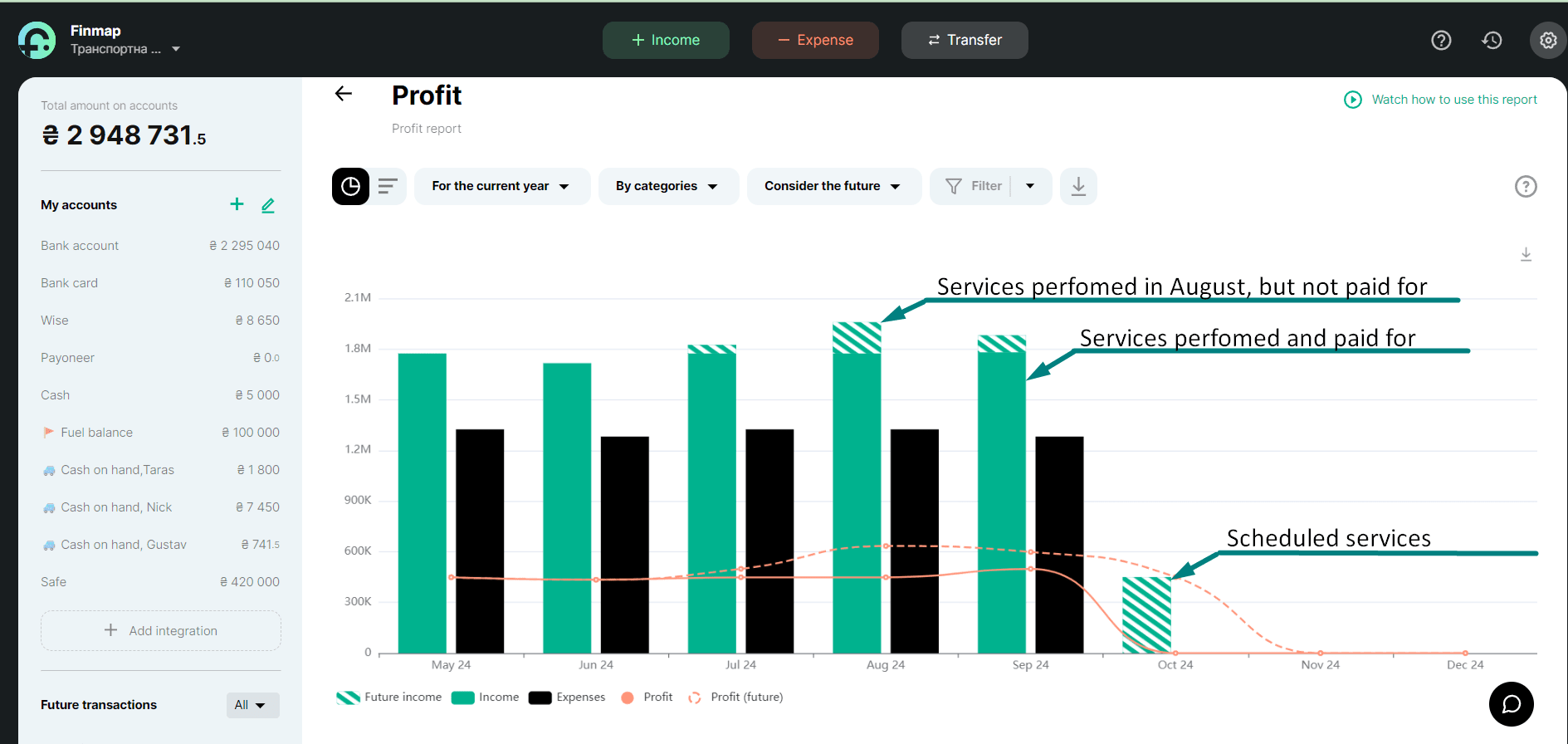
Such easy and at the same time detailed control of Receivables became possible only in Finmap, as self-made tables required constant expansion, modification and reconciliation of formulas.
How Finmap Replaced an Additional Operations Manager and Saved the Owner More Than $8,000 Per Year
Before the introduction of the service, the manager was engaged in cost accounting and entered them manually into the table. At the same time, when the drivers made expenses, they immediately wrote about it in the work chat, which was constantly filled with more and more new messages.
It was quite easy to lose important information in such a flow.
The communication process regarding accountable funds was long and confusing:
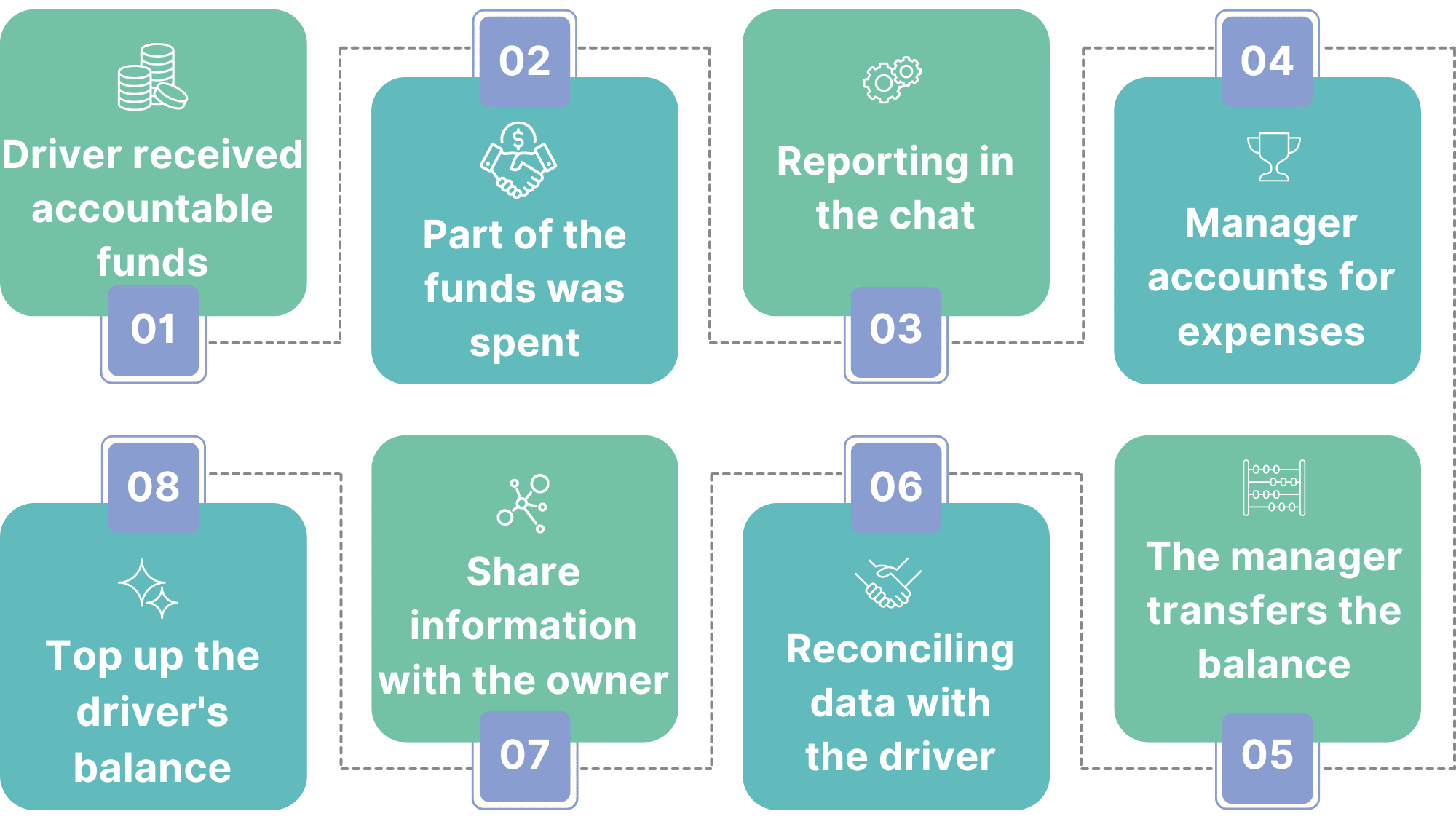
Such a process was carried out with each driver, of whom there were about 20 at that time. The workload was increasing, and the owner had already started the search for an additional operations manager.
How Finmap Optimized the Process of Working With Management Money
For convenience, drivers have been added as Users. For each of them, a separate account was created and access was granted only to it. These accounts show the funds available to the driver.

- Drivers independently pay expenses, attach checks, specify details and choose a project.
- Drivers independently add cash transactions to their accounts, with the corresponding settlement of the client.

Now the owner sees in real time:
- how much money was spent;
- what needs were the funds used for;
- balance on the driver's balance;
- whether the settlement was in cash;
- whether expenses did not go beyond the budget.
So, Andriy can now quickly compensate the driver for the spent funds, decide whether additional finances are needed, and does not waste time on clarifying the payment.
Such an innovation reduced the workload of the manager several times, and the need for additional personnel disappeared.
And now a little math (as of 09/20/2024):
- As the website Work.UA notes, the average salary of an operations manager in Ukraine is $750.
- So, in one year, Andriy had to pay $8 780.
- An annual subscription to Finmap costs $432.
Savings: 8 780 - 432 = 8 348
With the help of Finmap, drivers were also able to monitor the balance on their account at the fuel company, which allowed:
- To the owner —control the fuel consumption of each driver.
- To the drivers —promptly provide information on fuel limits.
- To the manager —manage general and individual fuel limits.
Finally, honest and transparent relationships are being built with my entire team, which is one of the keys to success for me. It is important that everything is enough for everyone, then the work of the drivers will be comfortable and the level of our service will only grow. — Andriy Antonenko, owner of LIBERT
Prospects for Further Cooperation Between Finmap and LIBERT
Easy implementation and use, coverage of most of the company's cases and optimization of business processes became the basis for strong and long-term cooperation with Finmap for Andrii.
I didn't even know if there were any similar programs or competitors to Finmap. And why, if this system completely satisfies me? It would be good for our business to be able not only to issue invoices in Finmap, but also to provide certificates of completed works. So we hope that we will wait for such innovations as well. — Andriy Antonenko, owner of LIBERT
Now, the reports generated automatically in the service provide the owner with comprehensive information about the state of his business. Finally, financial management became not a burden, but a convenient tool for the strategic and tactical development of the company.
Introduce Finmap and learn all the details of the financial status of your business. Optimize, save and grow with Finmap!
